

There is a video that circulates endlessly in guitar communities online — Tommy Emmanuel, alone on a stage with an acoustic Maton, playing a medley that moves through jazz, country, blues, and rock in the space of four minutes, and at no point during those four minutes does it sound like one guitar and one man. It sounds like a band.
Not a guitar player imitating a band. Not a clever approximation. A band — bass moving independently through chord changes while a chord strum sits above it while a melody dances across the top, all from one instrument, all from one set of hands, all without a loop pedal or any trick other than fifty years of the most disciplined fingerstyle practice in the history of acoustic guitar.
Tommy Emmanuel’s picking style is the endpoint of a tradition that runs from the coal fields of Kentucky through Nashville, and it is unlike anything else in the world. He has been performing like this since he was six.
The Australian Prodigy and the Letters from Nashville
Thomas William Emmanuel was born in Muswellbrook, New South Wales, Australia, on May 31, 1955. His father was a country music enthusiast who encouraged all his children to play. By the time Tommy was four, he was sitting in his father’s lap learning guitar basics. By six, he was performing publicly with his siblings as the Emmanuel Quartet, traveling regional Australia in a converted bus, playing venues wherever they could find them.
The family toured constantly — a childhood defined by music, movement, and the inside of a tour bus. Formal schooling was intermittent. Guitar practice was not. Tommy Emmanuel has estimated that he was playing eight to ten hours a day from early childhood — not as disciplined practice in the conventional sense, but as pure obsession, the way children who are genuinely called to something play.
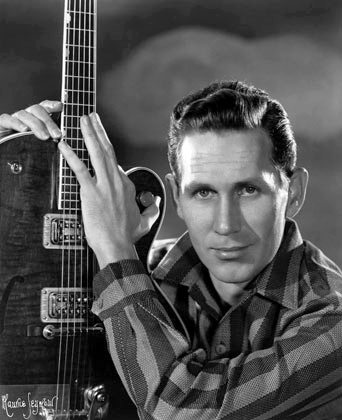
By his teenage years, he had absorbed American country guitar from records and radio — Chet Atkins above all others. The records of Mister Guitar were not casual listening for Emmanuel. They were study material. He listened to them until he understood every note, every thumb pattern, every tonal choice. Then he listened again.
In the late 1960s, Emmanuel wrote a letter to Chet Atkins. Not a fan letter — a guitarist’s letter. He described his playing, asked questions about technique, and enclosed a recording. Atkins, who received correspondence from aspiring guitarists constantly and answered relatively little of it, wrote back. A correspondence developed — two guitarists separated by age, geography, and circumstance, connected by a shared obsession with what the right hand could do. That correspondence would continue for decades, until Atkins’ death in 2001, and culminate in one of the most meaningful gestures in the history of the instrument. Read the full story of that extraordinary friendship in our article on Tommy Emmanuel and Chet Atkins — the letter that changed everything.
What Is a CGP? The Ultimate Title
In 1999, Chet Atkins created a designation he called Certified Guitar Player — a title he bestowed personally on guitarists he considered to have achieved mastery of the fingerstyle tradition he had spent his life developing and promoting.
He awarded it to exactly five people in his lifetime.
Tommy Emmanuel was one of them. At the ceremony where Atkins presented the CGP designation, Emmanuel reportedly wept. The man whose records he had studied obsessively from childhood, who had answered his letters, who had become his mentor and eventually his friend, was telling him formally: you have mastered this.
The other CGP recipients — Jerry Reed, Chet’s son Merle, Steve Wariner, and John Knowles — are all significant players in their own right. But Emmanuel’s CGP carries a particular weight because of the journey behind it: an Australian kid on a tour bus in the outback, writing letters to Nashville, building a technique in relative isolation, and arriving — through sheer obsession and discipline — at the pinnacle of the form.
The title is not honorary. It is a technical judgment. And it has defined Emmanuel’s career identity ever since.
The Illusion of Three Guitarists: Bass, Rhythm, and Melody

The central mystery of Tommy Emmanuel’s playing — the thing that stops guitarists in their tracks and sends them to YouTube to watch his hands — is the simultaneous independence of three musical voices from one instrument.
The bass: the thumb, wearing a thumbpick, drives an alternating bass pattern through every chord change with the consistency of a double bass player. It does not stop. It does not simplify when the melody gets complex. It maintains its own rhythmic and harmonic logic regardless of what the fingers are doing above it.
The rhythm: above the bass, chord stabs and rhythmic accents provide the harmonic context — the « band » behind the melody. These are not full strums. They’re precisely placed partial chords, voiced to sit between the bass line and the melody without cluttering either.
The melody: above the rhythm, a single-note melody moves with the freedom and expressiveness of a lead guitarist who has an entire rhythm section playing behind him. Because, in Emmanuel’s hands, he does.
The technique that makes this possible is pure Travis picking independence — the same thumb-driven alternating bass that Merle Travis developed, that Chet Atkins refined, that a generation of country and folk players absorbed. Emmanuel’s contribution is not the invention of a new technique. It is the development of that technique to its absolute outer limit.
Where Emmanuel goes further than anyone: the advanced moves that separate him from even excellent Travis pickers are the integration of percussion, harmonics, and position shifts into a seamlessly flowing arrangement. He taps the body of the guitar for kick drum effects. He sounds artificial harmonics — chiming bell tones — in the middle of fast passages. He shifts between first position, cowboy chords, and upper-register melody runs without any perceptible seam in the arrangement.
His Maton EBG808TE signature guitar — built by the Australian company he has endorsed exclusively for decades — is set up to facilitate all of this: light strings for easy harmonics, a body depth and width chosen for the specific resonance his right hand needs, a pickup system designed to capture the full dynamic range from soft fingerpicked passages to percussive body slaps. The guitar and the technique are inseparable. So are the decades of practice behind both.
Stepping Into the Shoes of the Masters
Watching Tommy Emmanuel can be intimidating. The gap between what he does and what most players do seems, at first glance, unbridgeable.
It isn’t. But the bridge requires starting at the beginning — the real beginning, not the intermediate exercises.
Every single mind-bending arrangement Emmanuel plays is built on a rock-solid traditional foundation. The bass line that seems impossibly fast is the alternating bass pattern from 1940s country guitar, practiced until it runs without conscious thought. The melody that seems to float free above the rhythm is possible only because the thumb has been trained to operate independently of everything else for decades. The percussion is the final layer — added after the musical foundation is completely secure.
He took the basic patterns of early country-blues and pushed them to their absolute physical limits. The patterns themselves are accessible. The limits are not — but they move further away with every hour of honest practice.
Want to start your own journey toward thumb independence? Start with the basics in our guide to Travis Picking vs. Chicken Picking — the foundational technique that Emmanuel, Atkins, and Travis himself all built their mastery upon.
Explore more player profiles and technique guides in our Playing Blues & Rock section.
Tags: Tommy Emmanuel picking style, Certified Guitar Player CGP, one man band acoustic guitar, advanced thumbpick technique, Maton guitars tone, Travis picking advanced, Chet Atkins influence, Playing Blues & Rock


No Comments