
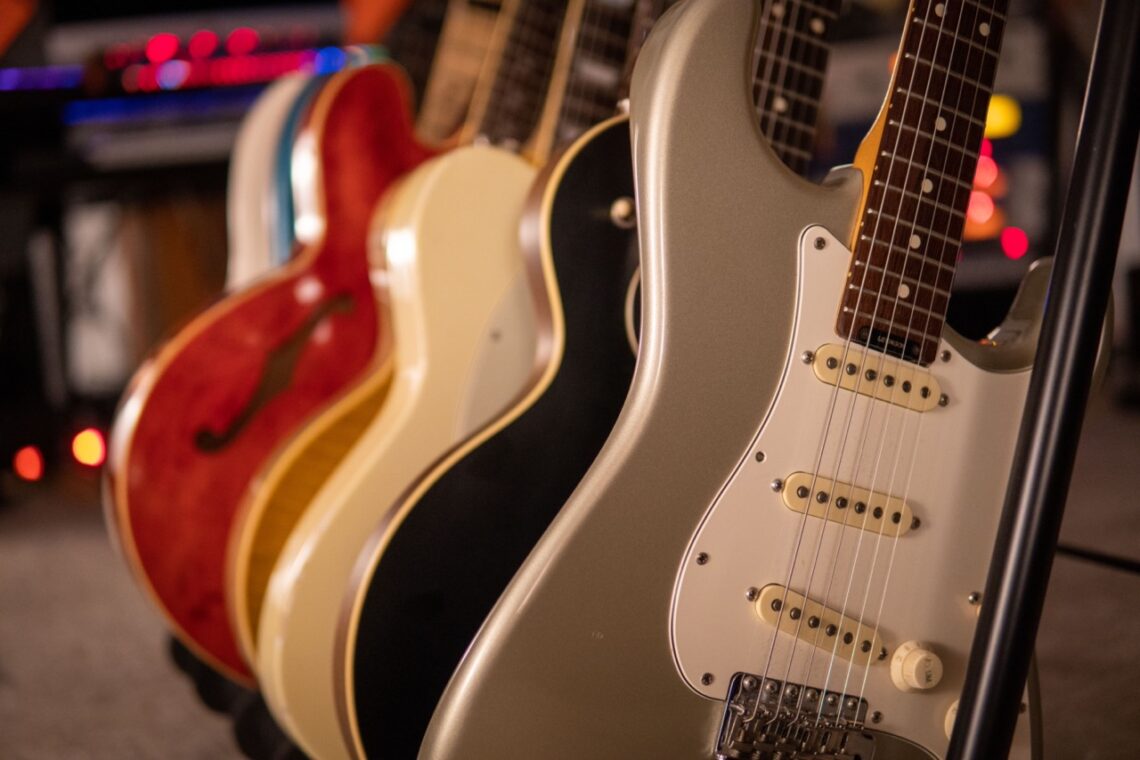
There is something genuinely thrilling about waking up on a Saturday morning, opening your phone, and finding a listing that makes your heart beat just a little faster.
That feeling — the rush of a potential find, the excitement of digging into specs and serial numbers, the joy of recognizing something rare that others have scrolled past — is exactly why I hunt vintage guitars. And I mean hunt. With curiosity, passion, and the kind of enthusiasm that turns an afternoon browse into a two-hour deep dive into 1974 Fender factory production records.
Every search is an adventure. Every guitar teaches me something new — about a specific production year, a rare finish, a factory transition, a detail that separates the real thing from a well-intentioned copy. And when I don’t buy? That’s not a disappointment. That’s a lesson learned, a skill sharpened, another piece of knowledge ready for next time.
What I’m looking for is specific: instruments as close to 100% original as possible. Original pickups, original pots, original finish — even if it’s checking and worn. Every component telling the same coherent story, untouched by a previous owner who decided to « upgrade » a piece of history into something ordinary. I’m after a fair price for a genuine piece of history — not a steal, just an honest deal on something exceptional. A true vintage, a rare FSR, a limited production run, a historically significant model, a collector’s piece with a real story behind it.
This is a living article — my personal journal of every serious find I’ve explored. Some were incredible discoveries. Some turned out to be traps. Some are the ones that got away and still make me smile thinking about them. Each one taught me something worth sharing.
When something truly exceptional crosses my path — a piece that deserves its own full story — it gets its own dedicated article and a link back here.
Come back often. There’s always another guitar out there.
The Acoustic Exception
#1 — Furch OM 35 SR (2015)- 1800€
Why I liked it: An unbeatable value-for-money ratio from elite Czech lutherie — the equivalent of a Martin or Taylor at €4,000, with a perfectly balanced, piano-like tone that genuinely surprised me.
Why I walked away: The visceral pull of a legendary electric — a Strat or a Tele — for the collection won that week. The heart wants what it wants.
What I’ve learned: The old nomenclature trap — and the opportunity it creates.
The « 35 » in the model name was Furch’s internal designation for the absolute top tier of their standard production catalog — finest wood grades, most careful selection, best construction available. When Furch later transitioned to their bespoke « Rainbow » custom series, those old series numbers disappeared from the catalog entirely.
Today, a used Furch 35 on the secondhand market is regularly undervalued by buyers who don’t recognize the old naming system — and occasionally mispriced by sellers who don’t either. Buying a used Series 35 means accessing the brand’s most premium tonewoods at a price that has become impossible to find new. That gap between actual quality and perceived value is exactly the kind of thing a serious hunter watches for.
The Real Vintage — 70s Stratocasters
#2 — Fender Stratocaster 1975 | « The Featherweight » – 4200€
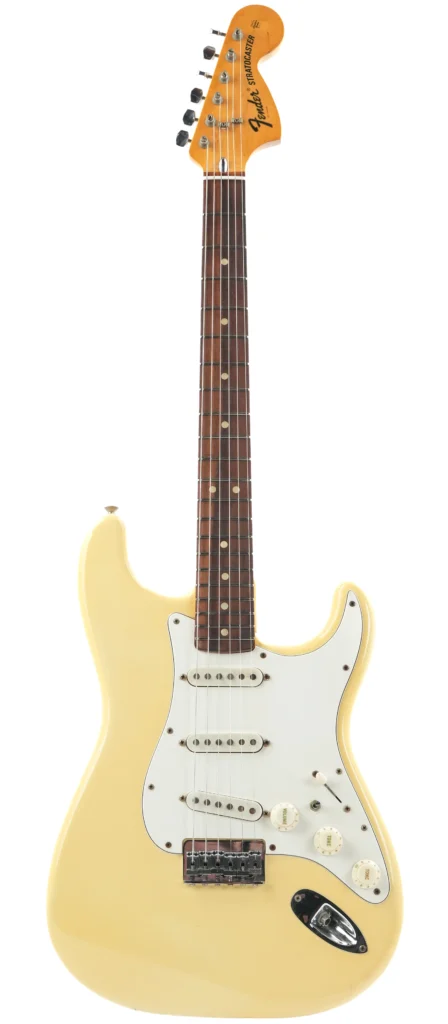
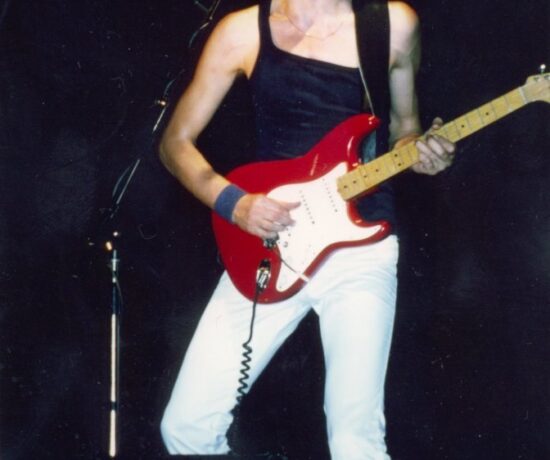
– Fender Stratocaster 1975
Why I liked it: An exceptional weight of just 3.2 kg — extraordinarily rare for a CBS-era Stratocaster — with original pickups and original pots. Everything in the electronics cavity was untouched.
Why I walked away: The pickguard had been drilled for an extra switch, a wild modification, and was potentially not original. At this price, that detail changes everything.
→ Full story here: The 1975 Fender Stratocaster That Stayed in the Shop: A Lesson in Vintage Hunting
What I’ve learned: The 70s modification trap — and why weight matters so much.
In the 1970s, guitarists massively modified their 3-position selector switches to 5-position ones to access in-between pickup combinations. Some did it cleanly — just swapping the switch. Others drilled the pickguard or even routed the wood cavity to add phase switches and extra controls. At this price point, any unauthorized drilling or routing in the wood permanently destroys the collector value. No exceptions.
The weight story is equally important. CBS-era Stratocasters from this decade are notorious for being heavy — often over 4 kg — due to thick polyurethane finishes and inconsistent wood selection. Finding a genuine 70s Strat at 3.2 kg is a genuine luthiery exploit. When you see that number, you stop scrolling.
Marketplace Traps & Enigmas
#4 — Fender Stratocaster | « The Fake American » – 3500€
Why I liked it: Listed as an early 80s American Fullerton reissue — a series every serious collector knows and respects. The hope was real.
Why I walked away: The serial number told a completely different story. Seven clean digits stamped at the bottom of a four-bolt neck plate, smooth surface above. That precise combination is not an American Fender. It is the exact production signature of the FujiGen factory in Japan, manufacturing MIJ (Made in Japan) Fenders between 1985 and 1986. A legitimate guitar in its own right — but worth around €1,500, not €3,500. Overpriced by €2,000.
What I’ve learned: Serial number placement and the logo don’t lie.
Fender never produced an American Stratocaster with 7 pure digits stamped at the bottom of a 4-bolt plate. That specific detail — smooth above, numbers below — is the fingerprint of FujiGen Japan. Learn this once and you’ll never overpay for a MIJ again.
About the logo, on Japanese Fenders from this era, the headstock decal was applied on top of the lacquer — not beneath it as on American models. Over time, that decal wears, lifts, and fades at the edges. If someone presents you a « vintage American Fender » with a headstock logo that looks rubbed or slightly translucent — that’s not honest age wear. That’s a Japanese instrument aging the way Japanese instruments age.
#5 — Fender Stratocaster | « The Plate 500 » – 3200€
Why I liked it: Vintage headstock profile, presented as an early 70s Stratocaster.
Why I walked away: 7-digits serial number beginning with « 500 » — pure digits, no letter prefix, no factory code. This corresponds to nothing in Fender USA’s production history. Numbers formatted this way appear on Squier Affinity and Bullet series guitars from the 2000s, or on parts-kit builds assembled from generic components and relisted with a fake vintage sticker.
What I’ve learned: When the serial raises doubt — go straight to the truss rod.
A genuine 1970s Fender Stratocaster has one specific detail at the headstock truss rod access: a chrome bullet-shaped nut. CBS introduced this in the early 70s for easier neck adjustments without removing the neck. What you should never see on an authentic 70s Strat is a black plastic teardrop insert or a wooden plug — those belong to Squier or parts-kit guitars. One look, ten seconds, case closed.
Marketplace fakers love the blur around serial numbers. They count on buyers not knowing the formats. Now you do.
Modern Signatures & USA Collector Models
#6 — Fender Stratocaster Eric Clapton Custom Shop (2006) – 4250€
Why I liked it: Impeccable Custom Shop build quality, Certificate of Authenticity, guitar in excellent health. By every objective measure — a fine instrument at a fair price.
Why I walked away: Too clinical. Active electronics requiring a 9V battery, a mid-boost circuit that compresses and polishes the tone into something modern and surgical. For all its craftsmanship, this guitar felt like a precision studio tool rather than a living, breathing instrument. No mojo, no passive magic.
What I’ve learned : The Blocked Tremolo — a permanent signature modification.
Eric Clapton never uses a tremolo arm. On every version of his signature Stratocaster — standard or Custom Shop — Fender installs a specific wooden block behind the tremolo spring claw, preventing any arm movement entirely. The tremolo is frozen. The bridge sits hard against the body like a hardtail: increased sustain, rock-solid tuning stability, different resonance through the body. Beautiful engineering — but know it before you buy, especially if you’re expecting a functioning vibrato.
#7 — Fender Stratocaster Eric Clapton « Seven Up » (1990) – 1900€
Why I liked it: A price that made me look twice — these normally trade above €2,500. The legendary « Seven Up » Candy Green finish, one of the most iconic and collectible colors in Fender’s entire history, produced for only a few years and inspired by a Seven Up soda can. Early Corona production wood. An honest, well-preserved example.
Why I walked away: The active electronics and Lace Sensor Gold pickups — Clapton’s signature sound on Journeyman and 24 Nights — deliver a compressed, ultra-quiet, modern character that sits at the opposite end of the spectrum from the warm, dynamic vintage passive tone I’m chasing.
What I’ve learned: Why Clapton used Lace Sensors — context changes everything.
Clapton performed in enormous arenas under massive lighting rigs generating intense electromagnetic interference. Standard single-coil pickups would have hummed unbearably under those conditions. The Lace Sensor Gold eliminated that problem entirely — near-zero noise, preserved output, the compressed tone that defined his 90s recordings. For his context, it was the perfect technical solution. For someone chasing the natural dynamics of a 1960s single coil in a small room — it’s the wrong pickup. Neither is better. They’re built for different worlds.
The « Seven Up Green » rarity is real and documented. If you ever find one in clean condition at a fair price — think twice before walking away.
#8 — Fender Stratocaster SRV Signature (1998) – 2200€
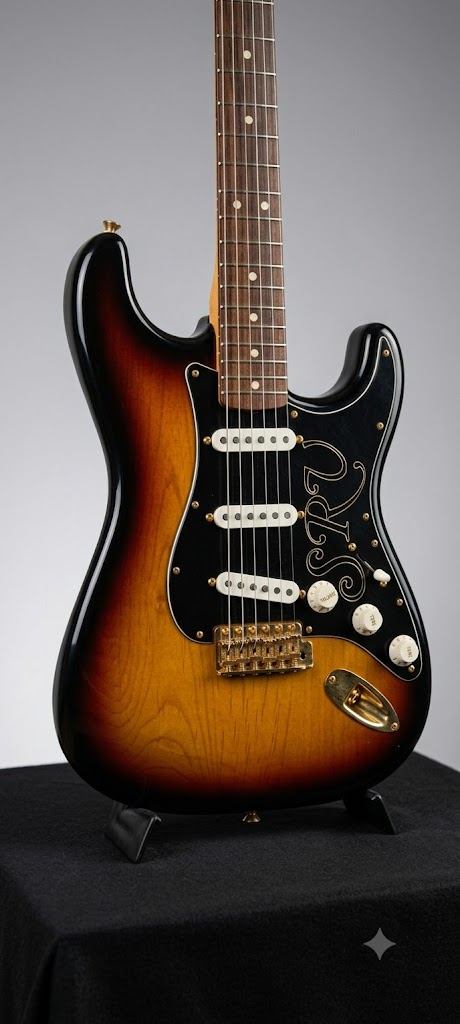
Why I liked it: A local find near my home town, near-mint condition, everything matching. A faithful tribute to Stevie Ray Vaughan’s legendary « Number One » — small vintage headstock, left-handed tremolo block mounted on a right-handed body, exactly as SRV configured his own instrument. His « Number One » was a hybrid: a 1959 body and a 1962 neck. Financially solid. Historically interesting. Practically on my doorstep.
Why I walked away: The wood is 26 years old, not 50. The resonance that comes from half a century of molecular change in dried, played, lived-in wood cannot be replicated or rushed. The search for a genuine vintage continues.
What I’ve learned: Master Grade Pau Ferro and the left-handed tremolo
In 1998, Fender used Pau Ferro fretboards on its American Signature series — the mandatory substitute for Brazilian Rosewood, under international trade restriction since the 1960s. What makes the 1998 SRV remarkable is the grade of Pau Ferro selected: dark, dense, heavily oiled, virtually indistinguishable from original Rio Rosewood in both appearance and tone. Modern Pau Ferro on Mexican-made instruments is frequently pale and dry by comparison. If you’re evaluating a late-90s American Signature Fender, the fretboard quality alone is worth a serious look.
An extra detail is the left-handed tremolo that is not an accident or a quirk — it’s a deliberate specification replicating SRV’s exact setup on Number One, giving the tremolo arm a different angle and feel in the right hand.
🎸 #9 — Gretsch Country Gentleman Chet Atkins Single Cut (2014) | BOUGHT
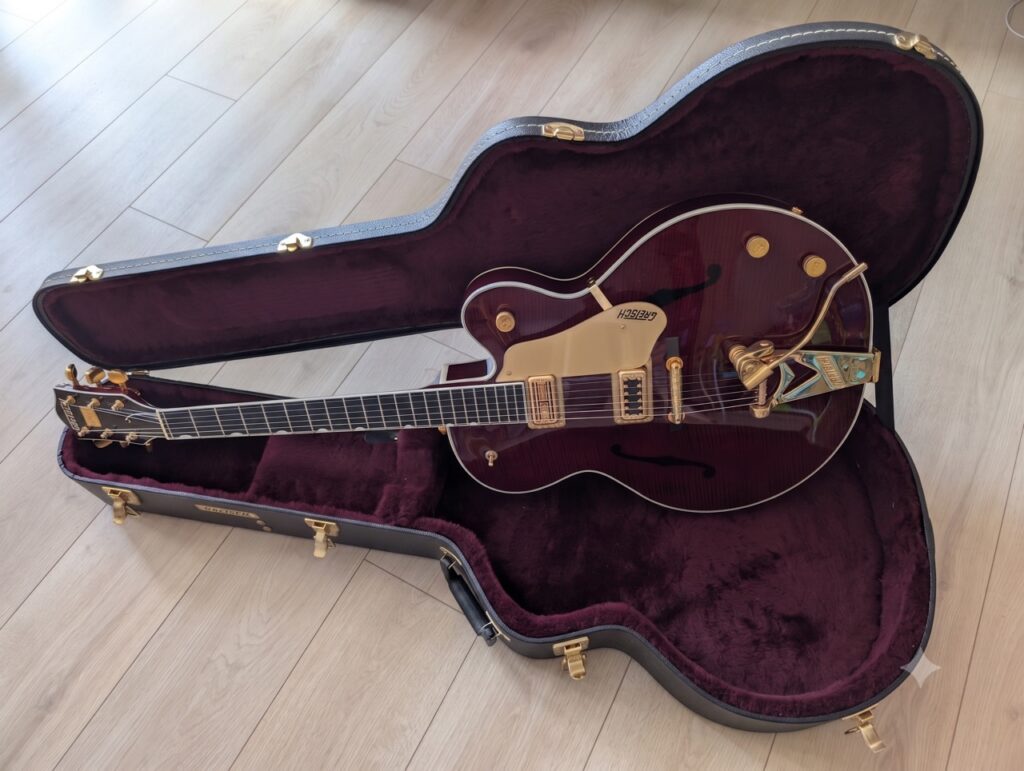
Price paid: €1,850 — original case, full documentation, condition near perfect
Why I liked it: The color. The sound. The history. From the very first photo, something about this guitar spoke directly to the rockabilly and rock’n’roll lover in me. A Gretsch Country Gentleman — Chet Atkins’ guitar, George Harrison’s guitar on the Ed Sullivan Show, the instrument that defines the bright, jangly joy of rock’s golden age. The Filter’Tron tone is pure and unmistakable — that articulate, chiming character that no other guitar quite replicates. In hand, the weight feels exactly right. You immediately sense you’re holding something serious. The Terada finish is staggeringly precise, down to the smallest detail. And the natural gold wear on the Bigsby and the bridge where your hand rests? That’s not a flaw. That’s mojo. Proof that this guitar was played and loved.
Why I bought it: Because some guitars don’t need negotiating. This one was right — the price, the condition, the provenance, the sound. And because after months of hunting, you have to know how to recognize the real thing when it finally shows up.
What I’ve learned – The secret of the fake f-holes and the Terada lineage
The first thing that surprised me holding this guitar: the f-holes are painted directly onto the wood. No opening, no cut through the top. The body is entirely sealed. I initially thought it was an anomaly — then I discovered it’s one of the most intentional and fascinating design decisions in the entire history of the Country Gentleman.
It was Chet Atkins himself who pushed for it. In the 1950s, hollow body guitars amplified at high stage volumes had a chronic problem: feedback. The hollow body would vibrate, pick up the speaker’s output, and send an uncontrollable howl back through the amp. Chet, who performed in large venues with powerful PA systems, had enough of it. He worked with Gretsch and engineer Ray Butts to find a solution. The answer: seal the body, block the parasitic vibration of the top, and paint the f-holes to preserve the hollowbody aesthetic without its acoustic drawbacks. The guitar remains hollow inside — but the top is fixed and controlled, eliminating feedback and improving sustain.
This detail, introduced progressively from 1962 on the Country Gentleman, became one of the most recognizable visual signatures in Gretsch’s history. And it was Chet Atkins — guitarist, sound engineer, innovator — who conceived it. Just as he had requested the Filter’Tron humbuckers from Ray Butts back in 1954, and the 17-inch thinline body that gives the Gent its unmistakable silhouette.
As for the Terada factory in Nagoya, it’s quietly remarkable how a newer version of this guitar can outperform the Brooklyn originals. This guitar belongs to Gretsch’s Professional Collection — the top tier of Japanese production. Since Fred Gretsch reclaimed the family brand in 1985 after the difficult Baldwin era, Terada has manufactured Gretsch’s professional models with a rigor and precision that many consider superior to the American production of pre-1967. The finish, the details, the assembly — everything confirms it the moment you pick it up.
→ Full story here: The Gretsch Country Gentleman Single Cut: A Purist’s Vintage Dream
What I’m Still Looking For
The first one is home. The Gretsch Country Gentleman sits in its original case, and every time I open it, that Walnut finish still stops me for a second.
But the search isn’t over. The ideal next find: a Fender Stratocaster from the late 1960s or early 1970s, all original components, under 3.5 kg, natural finish checking, no unauthorized routing, no replaced parts, no stories that don’t add up. A guitar that has been loved and played but never « improved. »
It exists. I know it does. I’ll find it.
And when something truly exceptional crosses my path, it gets its own article — with a link back here.
Until then, this page grows with every guitar I explore, analyze, and walk away from a little wiser..
Tags: vintage guitar hunting, fender stratocaster vintage, buying vintage guitar, all original vintage guitar, fender 70s stratocaster, guitar collector, fake vintage guitar, vintage guitar marketplace

No Comments