
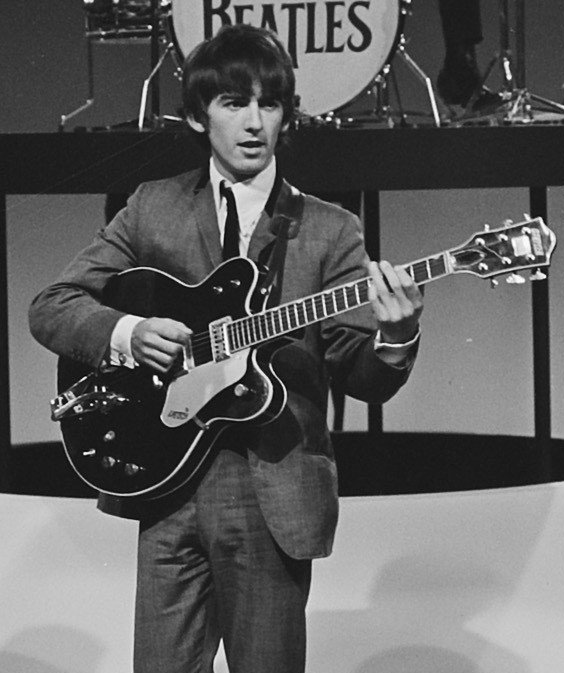
February 9, 1964. Studio 50, New York City. Seventy-three million Americans — nearly half the population of the United States — are sitting in front of their television sets.
The Beatles walk out onto the Ed Sullivan stage.
And in the back of the stage, the youngest Beatle — twenty years old, quiet, already the most instinctively gifted guitarist in the group — straps on a large, dark, elegant guitar that nobody in America has ever seen before. A guitar so dark in the black-and-white broadcast that most viewers assume it’s simply black. A guitar with painted-on f-holes, gold hardware, and a sound that cuts through the hysteria of 73 million people screaming at their TV screens.
The next morning, the Gretsch factory woke up to a backlog of orders it could not possibly fill.
That guitar was a Gretsch Country Gentleman. And George Harrison had just made it immortal.
1963: The Search for the Ultimate Single Cut
By 1963, George Harrison had already established himself as a Gretsch man.
His first serious American electric had been a black Gretsch Duo Jet — the guitar he played on the early Beatles recordings that would define a generation, including Please Please Me, I Saw Her Standing There, and Twist and Shout. But Harrison’s ear and his ambition were always moving forward. By 1963, he retired the Duo Jet in favor of a 1962 Gretsch Chet Atkins Country Gentleman.
The Country Gentleman was the pinnacle of the Gretsch lineup. It was Gretsch’s most prestigious model — the guitar that bore Chet Atkins’ name and reputation, built to the highest specifications the Brooklyn factory could manage. For the young Harrison, already obsessive about tone and deeply influenced by American country and rockabilly guitar, it was the natural next step.
Harrison actually acquired two Country Gentlemen during this period. The first, which had screw-down string mutes, was acquired in the spring of 1963 and was soon damaged — this was the guitar used to record She Loves You, the all-time best-selling Beatles single in the UK, in July 1963. The Country Gentleman he took to the United States was bought as a replacement in October 1963, with flip-up string mutes, and quickly became his prime instrument.
It was that October 1963 guitar — a 1963 model, not a 1962, despite the widespread confusion — that crossed the Atlantic with the Beatles in February 1964. And it was that guitar that was about to change American music history in a single Sunday evening.
The Sound That Shook the World: The Ed Sullivan Show
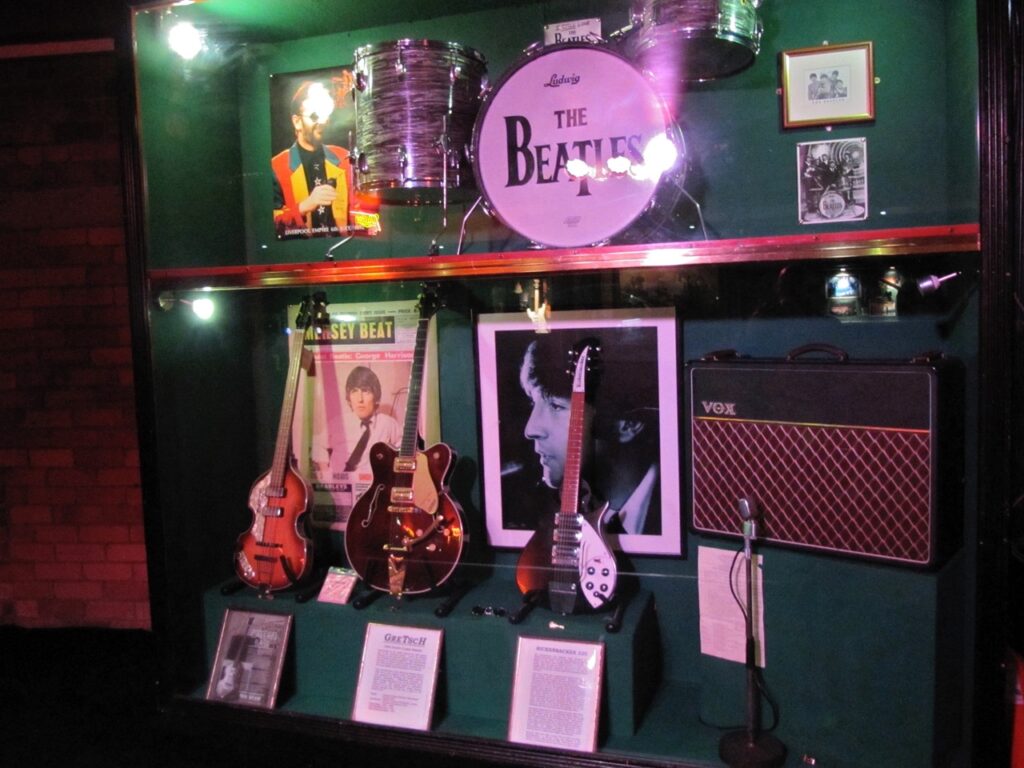
The numbers are almost impossible to process from a distance of six decades.
The Beatles’ appearance on The Ed Sullivan Show marked the beginning of the British Invasion and is widely regarded as the day popular music in America was changed forever. When Harrison stepped to the microphone with his Country Gentleman, he was playing to an audience larger than anything rock and roll had ever reached in a single moment.
The Ed Sullivan Show was broadcast in black and white, and the dark walnut stain finish of Harrison’s Country Gentleman « appeared nearly black » on television. It was a dramatic, imposing instrument — elegant and authoritative on screen, unlike anything American audiences associated with the guitars they knew. Among guitar collectors, darker brown Country Gents are still favoured over lighter ones to this day because of this association with Harrison.
The morning after the broadcast, the phones at Gretsch started ringing and didn’t stop.
Harrison himself later commented on the effect: « I read somewhere that after the Beatles appeared on the Sullivan shows, Gretsch sold 20,000 guitars a week, or something like that. I mean, we would have had shares in Gretsch and everything, but we didn’t know. »
Fred Gretsch — who would later own the company — worked for his uncle at the time and recalled that sales of Gretsch guitars immediately following the Beatles’ arrival in the United States « far exceeded » what the company could supply, with thousands of backorders.
One guitar. One Sunday night. An industry transformed overnight.
Dark Eyes and Simulated F-Holes: The Design Quirks That Define the Legend
The Country Gentleman that Harrison carried to America was not a conventional guitar — and its unconventional details are precisely what make it so fascinating to anyone who studies it closely.
The painted f-holes. The most striking detail on any Country Gentleman is the f-holes that aren’t f-holes at all — painted directly onto the sealed maple top, with no opening in the wood beneath them. This was a deliberate engineering decision, born from Chet Atkins’ frustration with feedback at high stage volumes. By sealing the body and painting the f-holes for visual continuity, Gretsch eliminated the feedback problem that plagued hollowbody guitars in loud live settings while maintaining the elegant aesthetic of a traditional archtop. The guitar remains hollow inside — but the top is fixed and controlled, producing better sustain and a cleaner, more focused tone.
The string mutes. Harrison’s 1963 Country Gentleman featured integrated flip-up string mutes — small felt dampers that could be engaged with a lever to mute the strings against the body, producing a dampened, percussive attack reminiscent of upright bass technique or early rockabilly rhythm playing. This was a Gretsch innovation that Chet Atkins had specifically requested for his signature models, and it gave the Country Gentleman a sonic versatility that few other guitars of the era could match.
The Walnut stain finish. The dark brown mahogany stain of Harrison’s Country Gentleman was the result of a heavy application of brown stain finish — not truly black, but so dark in certain lights that it photographed as black on the Sullivan show’s black-and-white cameras. This accident of broadcast technology became one of the most enduring aesthetic associations in guitar history: the dark Country Gent, forever linked to a young Beatle on the most watched television program in American history.
The Filter’Tron pickups. Developed by inventor Ray Butts in conjunction with Chet Atkins, the Filter’Tron humbuckers gave the Country Gentleman its defining tonal character — a bright, articulate, chiming quality quite unlike the warmer, rounder sound of PAF-style Gibson humbuckers. It is a sound that splits the difference between a single coil’s clarity and a humbucker’s body, producing the jangly, glassy tone that defines rockabilly, early rock and roll, and the particular Gretsch sound that Harrison loved.
Tragic Fate: The Highway Disaster
Every great guitar story has a shadow to it.
Harrison’s relationship with his Country Gentlemen ended in the most dramatic way imaginable. On December 2nd, 1965, during the Beatles’ final British tour, one of his Country Gentlemen — strapped to the roof of their car between venues — fell onto the road as the vehicle hit a bump on the motorway. It fell into the path of oncoming traffic. About thirteen lorries went over it before the chauffeur could get near it.
Harrison later said: « Some people would say I shouldn’t worry because I could buy as many replacement guitars as I wanted, but you know how it is, I kind of got attached to it. »
The guitar destroyed that day was the 1962 model — the first of his two Country Gentlemen, which he had taken to a repair shop while using the 1963 model, and then apparently brought back on the road. The 1963 Country Gentleman — the one that appeared on the Ed Sullivan Show — survived. It is now owned by Ringo Starr.
After losing the Country Gentleman on the motorway, Harrison moved on to a double-cutaway Gretsch, and eventually the Fender Telecasters and Stratocasters that would define his later sound. But the Chapter — those three extraordinary years with the single-cut Country Gentleman — had already written itself into history.
Owning a Piece of the Legend
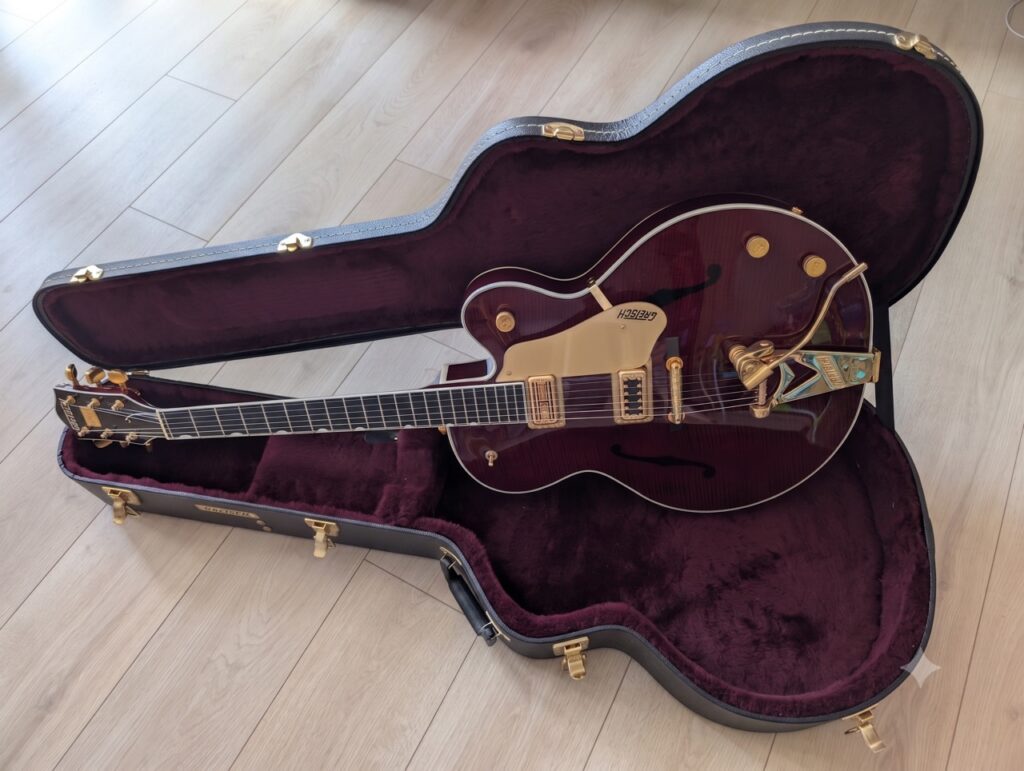
The single-cut Country Gentleman from the early 1960s remains the most sought-after version of the model among serious collectors — the configuration that Harrison played, the shape that appeared on that Sullivan stage, the silhouette that launched Beatlemania in America.
Original 1962 and 1963 models in authentic condition trade in the territory of serious vintage investment. But Gretsch’s Professional Series reissues — built at the Terada factory in Nagoya, Japan, to exacting specifications — capture the essential character of the original: the sealed body, the painted f-holes, the Filter’Tron pickups, the Bigsby vibrato, the dark Walnut stain.
For modern collectors, finding a meticulously crafted reissue of this early Single Cut era — complete with its original documents and the natural patina of time — is the ultimate reward. Follow my own hunt for a Gretsch Country Gentleman in my field journal: My Vintage Guitar Hunting journal — including the Gretsch Country Gentleman JT14 I recently tracked down.
Because some guitars don’t just play music. They carry the memory of a Sunday night in February 1964, when a quiet young man from Liverpool walked onto the most-watched stage in America and changed everything.
Fascinated by the guitars that shaped rock history? Explore more in our Blues & Rock Legends section — and discover the story of the man who first put Chet Atkins’ name on this guitar in our upcoming article on the Country Gentleman’s original architect.
Tags: George Harrison Gretsch, Country Gentleman, Single Cut Country Gentleman, Beatles Gretsch sound, 1962 Gretsch Country Gent, Ed Sullivan Show guitar, George Harrison guitars, Filter’Tron pickups, Blues & Rock Legends


No Comments