

Imagine being a child in rural Australia in the 1960s. No internet. No YouTube. No way to find out how your heroes played, where they lived, or whether they would ever know you existed.
Tommy Emmanuel knew one thing: Chet Atkins lived in Nashville. And Nashville was in America.
So he addressed an envelope — « Chet Atkins, Nashville, America » — put a letter inside describing his love of the music, enclosed whatever he could find to show he was serious, and sent it into the void. This is the story behind one of the most extraordinary friendships in guitar history — Tommy Emmanuel and Chet Atkins — a relationship that began with a stamp and a prayer, and ended with the most prestigious title in fingerstyle guitar.
It arrived. Chet read it. And he wrote back. The rest is history.
The Boy on the Bus
William Thomas Emmanuel was born in 1955 in Muswellbrook, New South Wales — a coal-mining town in rural Australia that had no particular claim to musical significance. What it had was a family: a father who loved country music, a mother who kept the household running while the records played, and a set of children who between them would become professional musicians almost from the moment they could hold an instrument.
Tommy was performing publicly by the age of six. Not performing in the sense of school concerts or birthday parties — performing professionally, on a circuit of regional venues, travelling with his family in a converted bus that served simultaneously as transport, rehearsal space, and home.
Shortly after his father’s death in 1966, Tommy wrote Chet a letter and, to his surprise, the famous artist and producer wrote him back. Chet would grow to become Tommy’s mentor and primary influence, but it would be another 15 years before the two would finally meet in person.
The records that reached Australia in those years were filtered and incomplete — you heard what made it across the Pacific, not everything that was being made. They heard Elvis, the Beatles, some R&B, Chuck Berry. But somehow, through whatever pathway the music took, Chet Atkins reached Tommy Emmanuel. And Tommy Emmanuel never recovered.
The Letter
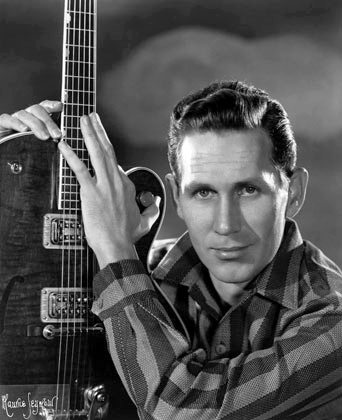
He was a young teenager when he wrote it. The address on the envelope was optimistic to the point of absurdity: « Chet Atkins, Nashville, America. » No street. No zip code. Just a name, a city, and a country.
« It got to him, and he answered it! I’ll never forget, I came home from school and my mother said, ‘Put your bag down and go into your room, there’s something on your bed for you.’ There’s this big brown envelope, I open it, and inside was a black-and-white photo of Chet with his Gretsch, and he’s wearing a Perry Como–style cardigan, his hair looking perfect. He signed it ‘Best wishes to Tommy, from Chet.' »
He still has that photo.
« It made me think that if a boy from nowhere could write to the greatest instrumentalist of all time, and get a reply, then anything is possible. »
That envelope, that photograph, that signature — they were not just a childhood thrill. They were a commitment. A boy from nowhere had contacted the greatest guitarist in the world and been acknowledged. That acknowledgment carried an obligation: to become worthy of it.
Nashville, 1980: Knocking on the Door
Fifteen years passed between the letter and the meeting. Fifteen years of practice, of touring, of developing a fingerstyle technique on the road that encompassed country, blues, jazz, rock, and anything else that came his way.
In 1980, Tommy Emmanuel came to America for the first time. And he went to Nashville. And he went to Music Row. And he knocked on Chet Atkins’ door.
« He had a lady named Caroline working for him and I knocked on the door and she let me in. I had my guitar and I had a photo album with photos of me holding up his albums and stuff as a kid. I’m waiting downstairs and she gets on the intercom and says, ‘There’s a boy from Australia here to see you.’ And I hear him say, ‘Is he a fingerpicker?’ She looks at me and I go, ‘Yeah!’ She goes, ‘He says he is.’ [Chet says], ‘I’ll be right down.' »
Three words decided it. Is he a fingerpicker? In Chet Atkins’ world, that was the only question that mattered. Technique could be assessed in thirty seconds. Character took longer. But if the hands were right, the conversation could begin.
« When I got to Nashville the first time in 1980 I called him and he said, ‘Do you want to pick a little?’ It was beautiful. It was like he knew what I was going to do before I did it. »
The Friendship That Shaped a Career
What began as a pilgrimage became a friendship that lasted until Chet Atkins’ death in 2001.
Chet took the twenty-something Australian ace under his wing and began introducing him to other guitar legends. Tommy speaks of his mentor with the love and gratitude of a son, and Atkins’ influences are evident throughout his music and personal philosophy.
The professional collaboration came in 1996. Tommy’s dream of recording with Chet Atkins came true when the pair made an album titled The Day the Finger Pickers Took Over the World, for which Emmanuel received his first Grammy award nomination. It was Atkins’ last recorded album before he died — a passing of the torch that neither of them could have fully anticipated when they made it.
Then, in 1999, came the moment that defined Emmanuel’s career identity permanently. At the age of 44, he became one of five people ever named a Certified Guitar Player (CGP) by his idol, music icon Chet Atkins.
Five people. In the entire history of the guitar. That is the list Tommy Emmanuel’s name appears on. To understand the full story of the man who created that title — and co-designed the guitar that Emmanuel plays to this day — read our portrait of Chet Atkins: Mr. Guitar and the Nashville Legend.
The Beatles and the One-Man Show

There is something that Tommy Emmanuel does in concert that stops audiences cold every time. He plays the Beatles.
Not a song. A medley — She’s a Woman, Please Please Me, While My Guitar Gently Weeps, Day Tripper, Lady Madonna — rolling from one into the next without pause, the right hand maintaining its alternating bass while the melody shifts through key changes and arrangements that would challenge a full band. His Live at the Sydney Opera House album features an astonishing Beatles Medley that Premier Guitar described as reminding listeners that « his fingerpicking is in a stratum all its own. »
The Beatles connection is not incidental. Emmanuel grew up with the Beatles the same way he grew up with Chet Atkins — as one of the voices that reached rural Australia through the radio and the record player, as one of the sounds that made music seem like the only thing worth doing with a life.
Playing their songs in fingerpicking arrangements — turning Day Tripper‘s riff into a self-contained guitar piece, finding the bass line and the melody and the rhythm all in one set of hands — is his tribute to the music that shaped him, delivered in the technique that Chet Atkins taught him was possible.
Eric Clapton and Chet Atkins both said that he is the greatest guitarist they ever saw. Todd Rundgren stated: « The two best guitarists in the world are Tommy Emmanuel. » The boy who addressed an envelope to « Chet Atkins, Nashville, America » ended up being called the greatest guitarist in the world by the man who answered it.
Want to understand the technique behind the magic? Read our guide on Chet Atkins’ fingerstyle secrets — the method that Emmanuel absorbed through a lifetime of devotion. And for the foundational patterns that connect them both, explore our breakdown of Travis Picking vs. Chicken Picking.
Tags: Tommy Emmanuel Chet Atkins, Tommy Emmanuel Beatles covers, CGP Certified Guitar Player, Tommy Emmanuel Nashville story, acoustic guitar legend, fingerstyle guitar masters, Blues & Rock Legends

No Comments