

In 1959, the Gibson factory in Kalamazoo, Michigan, made a mistake. A worker installing the neck pickup in a Les Paul Standard reversed the polarity of the magnet. Not by design. Not as an experiment. By accident — the kind of anonymous, unremarkable workshop error that happens thousands of times a day in manufacturing facilities, leaves no trace in any record, and is forgotten before the end of the shift.
This particular error was not forgotten. It produced, entirely by chance, one of the most sought-after guitar tones in the history of rock — a sound so distinctive, so immediately recognizable, and so impossible to fully replicate that three of the most respected guitarists of the past sixty years have owned this single instrument, and two of the world’s largest guitar manufacturers have built entire product lines trying to capture what that misplaced magnet created.
This is the story of Greeny — the Peter Green Les Paul that made rock history.
The Accident: What Out-of-Phase Actually Means
To understand what makes Greeny unique, you need to understand what « out-of-phase » means in practical terms.
In a standard Les Paul, both pickups are wound and oriented in the same direction. When you select both pickups simultaneously — middle position on the selector switch — the two signals combine in phase, producing the full, warm, slightly thicker tone that is the Les Paul’s characteristic center position sound.
When one pickup’s polarity is reversed — as happened in Greeny’s neck pickup — selecting both pickups simultaneously creates partial phase cancellation. The two signals partially cancel each other out, removing certain frequencies and producing a thinner, more nasal, more hollow sound. Not the full cancellation of true out-of-phase wiring, which produces a very thin, weak tone — but a partial cancellation that cuts the midrange in a specific way, creating a sound that sits between the warmth of a humbucker and the clarity of a single coil.
The result is what Kirk Hammett described as sounding like « a Strat through a 100-watt Marshall stack. » A Les Paul that, in its middle position, produces a vocal, expressive, almost human-sounding tone that no other Les Paul produces.
The factory worker who reversed that pickup never knew what he had done. The guitar was shipped, sold, sat somewhere for six years, and arrived at Selmer’s music shop on Charing Cross Road in London around 1965. Where Peter Green was waiting.
Peter Green: £114 and a Sound That Made BB King Sweat
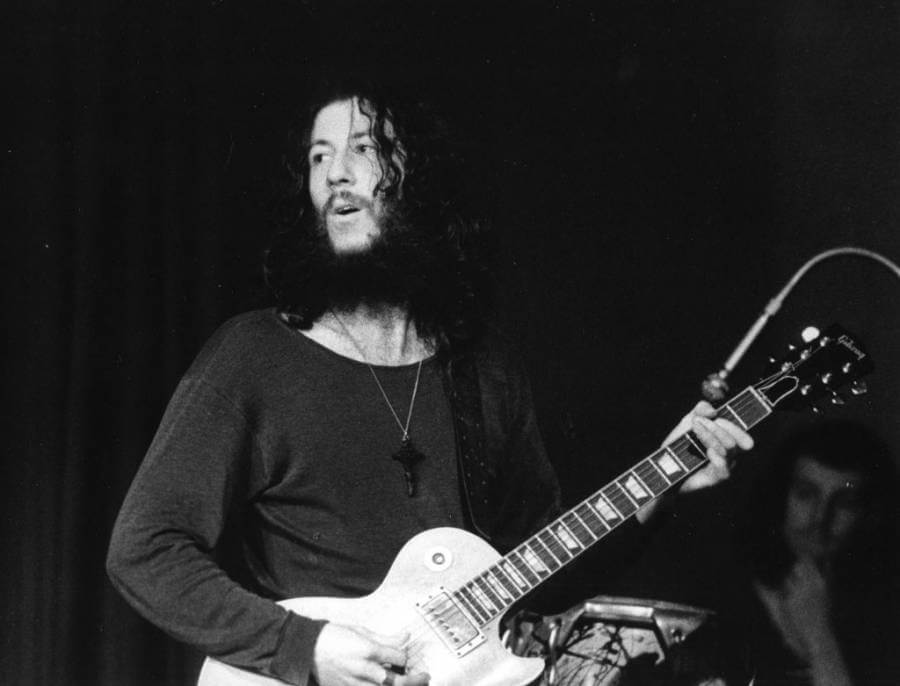
Peter Green bought Greeny for £114 at Selmer’s in 1965. He had no particular knowledge of its unusual wiring. He bought it because it sounded extraordinary — and it did, for reasons he couldn’t fully explain.
« I didn’t know what out-of-phase meant, » Green said years later. « I didn’t know there was anything special about it. »
He took it to John Mayall’s Bluesbreakers, where it produced the sound on A Hard Road — the haunting, vocal tone that distinguished Green’s playing from every other Les Paul player in London. Then he took it to Fleetwood Mac, where it defined the sound of Black Magic Woman, Oh Well, and The Green Manalishi. The guitar and the player became inseparable in the public imagination.
The out-of-phase tone appears most clearly in the middle position — both pickups engaged, the reversed polarity doing its work. On The Green Manalishi, recorded in 1970 just before his departure from Fleetwood Mac, you can hear it clearly: a nasal, snarling, almost menacing quality that no standard Les Paul produces, the sound of partial cancellation turned into musical expression.
BB King, asked about Green, said he was the only player who gave him the cold sweats. The instrument responsible for that reaction cost £114. Read the full story of the man behind the guitar in our portrait of Peter Green and the birth of Fleetwood Mac.
Gary Moore: The Devotee Who Played It for 25 Years
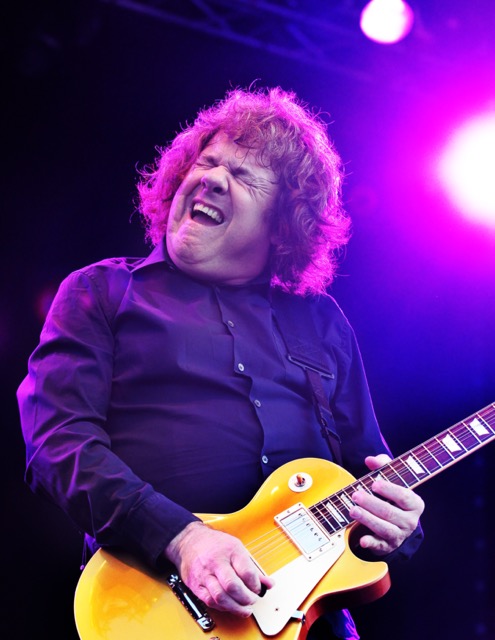
In the early 1970s, Peter Green — his mental health deteriorating — sold the guitar to Gary Moore. The price has been reported as a nominal sum — possibly a few hundred pounds. Green seemed largely indifferent to the financial transaction. Moore was not indifferent to anything about the instrument.
Gary Moore was an Irish blues guitarist from Belfast who had idolized Peter Green since his teenage years — with the same intensity that Tommy Emmanuel idolized Chet Atkins. Acquiring Greeny was not a collector’s transaction. It was a pilgrimage completed.
Moore played Greeny for over twenty-five years. He used it on the 1995 tribute album Blues for Greeny — an entire record dedicated to Green’s compositions, played on Green’s guitar, by the man who considered Green the greatest blues guitarist he had ever heard. The album is one of the finest tributes in the history of the genre: direct, technically superb, emotionally honest, and made possible entirely because Moore owned the instrument Green had used to create the originals.
In 2006, facing financial difficulties, Moore sold the guitar. It passed through several private transactions before arriving at its current home.
Kirk Hammett: Playing It Every Night

Kirk Hammett acquired Greeny in 2014 for a reported price in the region of $2 million. His reaction to holding it for the first time was that of a fan who has arrived at the end of a very long journey: « I was so friggin’ blown away by the fact that I was holding a guitar that Peter Green played in Fleetwood Mac and then Gary Moore played for, like, 25 years after. »
What he did next is what defines his ownership. He plays it. Live. Every night. On stage with Metallica, in front of audiences ranging from club-sized to stadium-scale, Greeny does what it was built to do: make sound.
Joe Bonamassa assessed this directly: « Collecting is about what you love and what you’re gonna do with it. PG’s Les Paul gets played every night. » Hammett refuses to let the guitar become a museum piece. The instrument that cost £114 in 1965 and is now worth $2 million goes on the road. Read the full story of the man who plays it in our article on Kirk Hammett — the metal legend who never stopped learning.
The Replicas: Chasing the Accidental Tone
The « Peter Green mod » — reversing the neck pickup magnet to create the out-of-phase effect — has become one of the most popular modifications in the Les Paul world. Players have been doing it to their own instruments for decades, chasing the specific tonal character that the Kalamazoo factory created accidentally in 1959.
Gibson recognized the demand formally. The Gibson Custom Shop produced two limited runs of Greeny replicas in 2010 and 2022, before the guitar was added to Gibson’s core lineup in 2023. Each replica includes the reversed pickup orientation as a standard feature.
For players who want to explore the sound without the $2 million price tag, Epiphone also produces a Greeny-inspired Les Paul at an accessible price point — available from major retailers including Reverb. The out-of-phase tone in the middle position, the dark sunburst finish, the hardware faithful to the 1959 original. Not Greeny. But the closest most of us will ever get to understanding what that factory worker accidentally created in Kalamazoo sixty-five years ago.
Explore more gear stories and instrument deep-dives in our Tone & Gear section.
Tags: Peter Green Les Paul Greeny, Gary Moore Les Paul, 1959 Gibson Les Paul Standard, out-of-phase guitar tone, Kirk Hammett Greeny, Gibson Les Paul history, Tone & Gear

No Comments