
Eighty-eight miles per hour. That’s the magic number. The precise speed the DeLorean needs to hit before the flux capacitor kicks in and tears a hole through time itself.
And in October 2025, Gibson chose that exact number — 88 — to define the most exclusive guitar release of the year. Eighty-eight handcrafted Gibson Custom Shop ES-345s, built to celebrate the 40th anniversary of Back to the Future. Alongside them: 1,985 Epiphone versions — one for each year the film first hit theaters.
Both sold out almost instantly. Both are now trading on the secondhand market at prices that raise one very important question: is this a nostalgic scam, or a genuine collector’s opportunity?
I’m currently negotiating to buy one. Here’s everything I’ve learned in the process.
What Guitar Did Marty McFly Actually Play in Back to the Future?
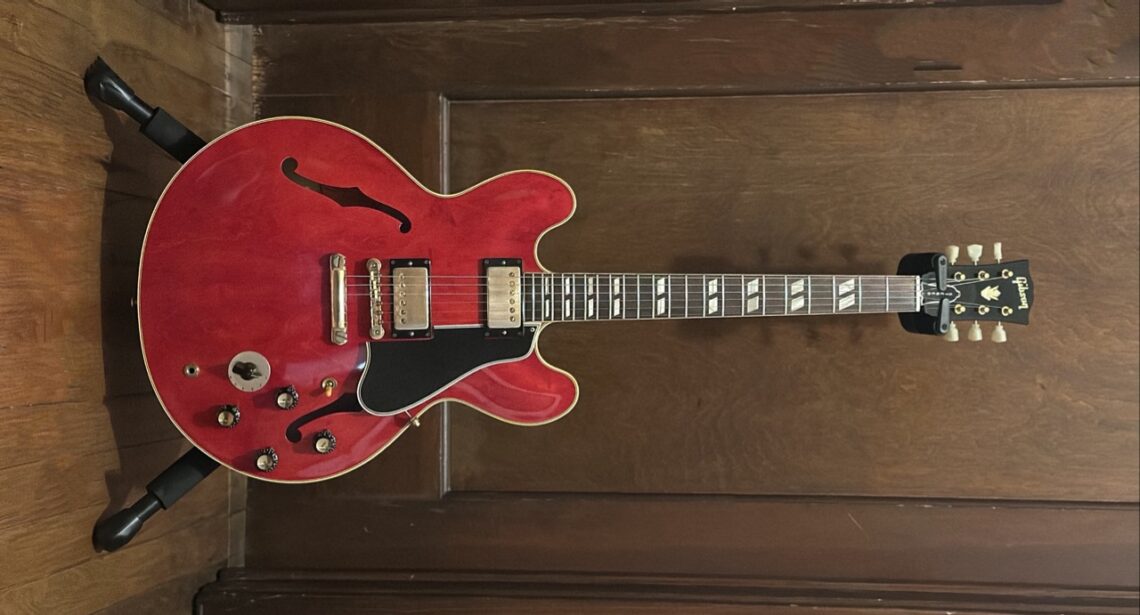
It’s the iconic Gibson ES-345 in Cherry Red — and it comes with one of cinema’s most charming anachronisms. The film is set in 1955. The ES-345 wasn’t introduced until 1958. So when Marty McFly straps on that cherry red semi-hollow and tears into Johnny B. Goode at the Enchantment Under the Sea dance, he’s playing a guitar that technically doesn’t exist yet in the film’s timeline.
Nobody cared then. Nobody cares now. Because that scene — Fox windmilling, duck-walking, channeling Chuck Berry through a 1959 ES-345 — is one of the most electrifying moments in the history of music on film.
The original guitar used during filming has never been found. Gibson launched a worldwide search in 2025, enlisting Michael J. Fox, Christopher Lloyd, Lea Thompson and Huey Lewis to help track it down. As of this writing, it remains lost to time — which only deepens the mythology around every guitar connected to this story.
The Gibson Custom Shop Version: 88 Units, $20,000, and a Masterpiece You Can’t Have
« How many Gibson Custom Shop Back to the Future guitars were made? »
Exactly 88. Not a round number chosen for marketing convenience — a number loaded with meaning. Eighty-eight miles per hour. The flux capacitor threshold. The speed of time travel. Gibson didn’t just build a tribute guitar; they embedded the mythology into the production number itself.
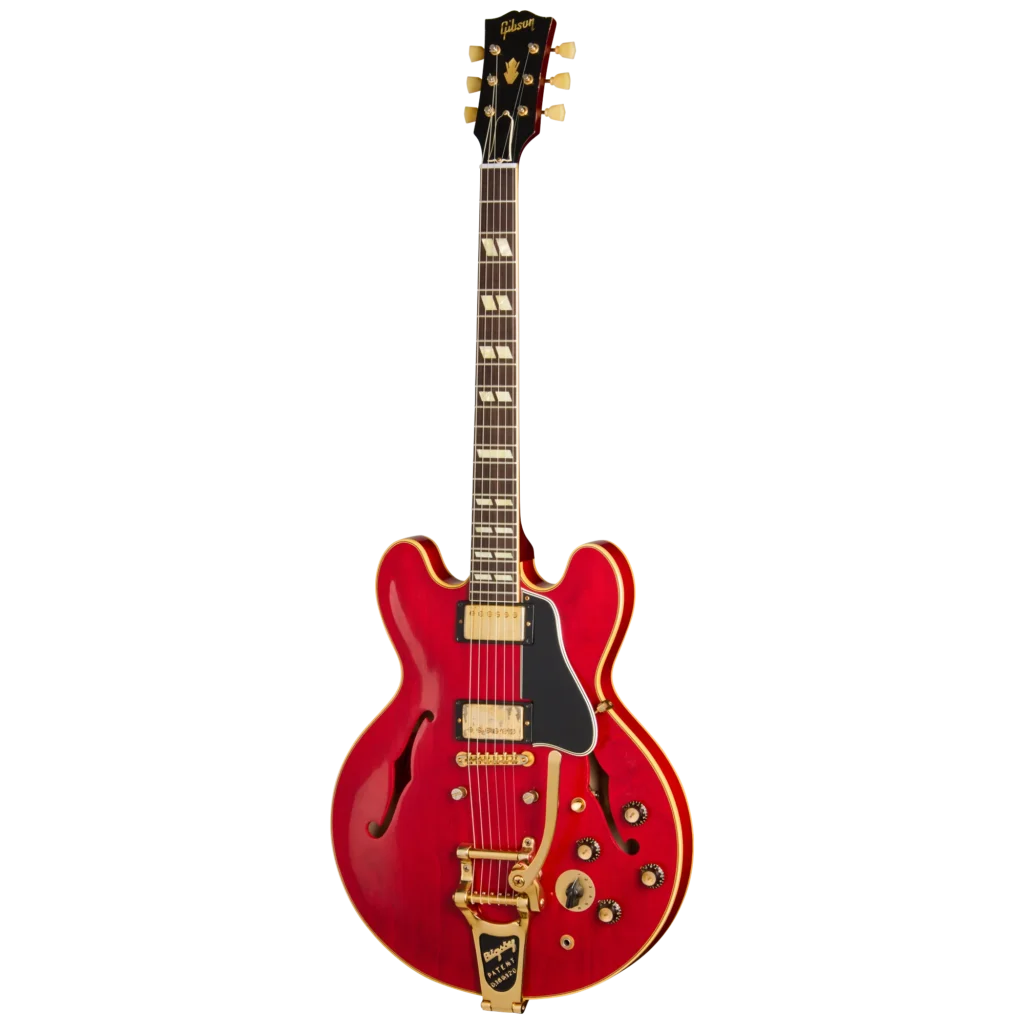
Each of these 88 instruments is a Gibson Custom Shop « 1955 » ES-345 Collector’s Edition, handcrafted in Nashville, Tennessee, and aged by the legendary Murphy Lab team. The specs are extraordinary:
- Body: Thinline three-ply ES™ construction — maple, poplar, maple — with a solid maple centerblock for sustain and feedback resistance
- Neck: Mahogany, long tenon, hide glue joint, 1961 Authentic Thin D-Shape profile
- Fretboard: Bound rosewood, 22 medium jumbo frets, celluloid split parallelogram inlays
- Pickups: Unpotted Gibson Custombucker humbuckers, Alnico 3 magnets, hand-wired to individual volume and tone controls with CTS potentiometers and paper-in-oil capacitors
- Hardware: Aged gold throughout — Bigsby B7 vibrato, ABR-1 No-Wire bridge, Kluson tuners
- Aging: Full Murphy Lab treatment, replicating the worn-in character of a guitar played through decades
- Special detail: A single parallelogram inlay at the 12th fret — replicating the only known example from the original era ES-345 with this specific feature
Retail price: $19,999.
They sold out on Gibson’s website before most people even knew they existed. If you find one now, you’re dealing with a private collector who knows exactly what they hold.
The Epiphone Version: 1,985 Units and the Secondary Market Chaos
« Is the Epiphone Back to the Future guitar a real Gibson replica? »
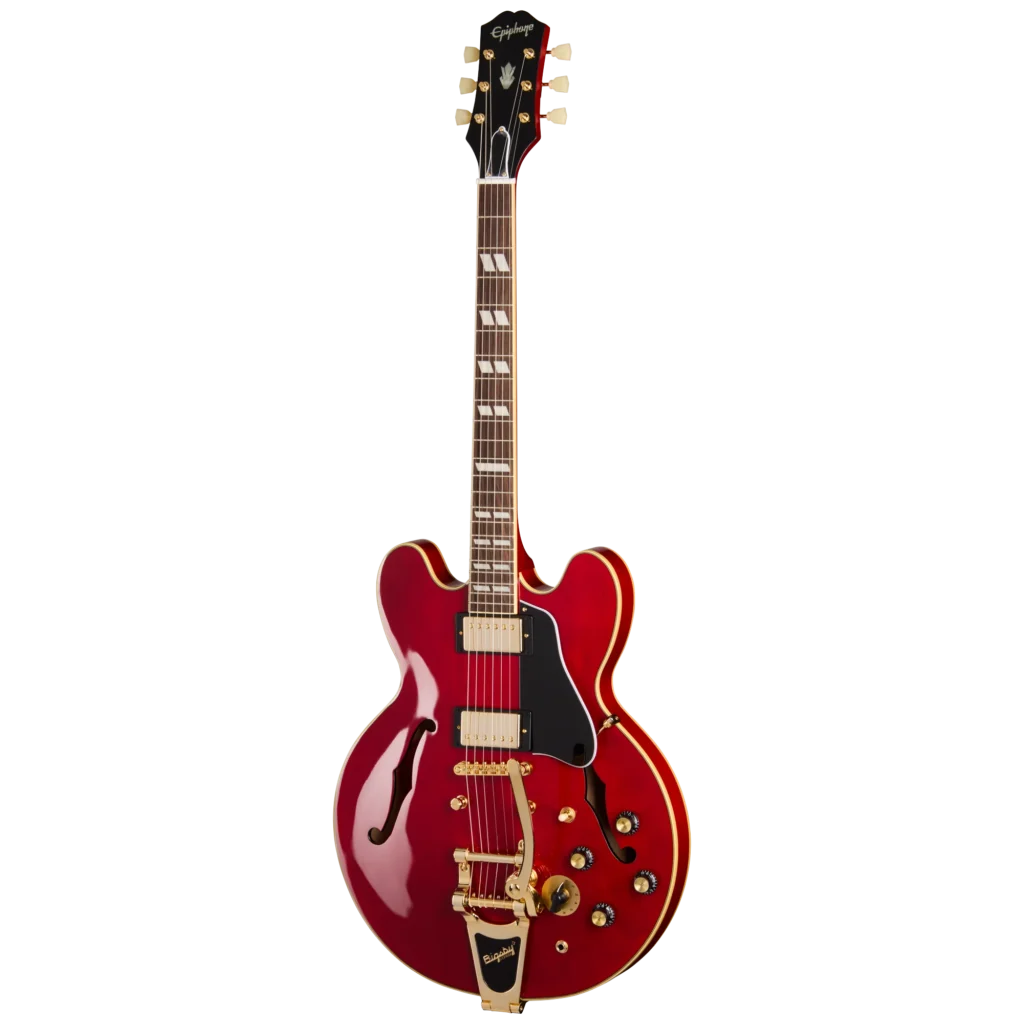
Not a replica in the technical sense — and that’s an important distinction. The Epiphone Back to the Future ES-345 is built to Epiphone specifications, with Epiphone components, at an accessible price point. It shares the visual identity of the film guitar — Cherry Red finish, Bigsby vibrato, gold hardware, varitone switch, the signature 12th fret inlay detail — but it is not a Custom Shop instrument.
What it is:
- Limited to 1,985 units worldwide — a direct reference to the year Back to the Future was released in theaters
- Body: Semi-hollow ES-345 profile in Cherry Red
- Pickups: Epiphone Alnico Classic PRO humbuckers with individual volume and tone controls and a mono Varitone circuit
- Hardware: Gold LockTone Tune-O-Matic bridge and Bigsby B70 vibrato tailpiece
- Case: Retro-style hardshell case featuring Marvin Berry and the Starlighters graphics — a detail that alone justifies collector interest
- Retail price: $999 / £949
It captures the look of the film guitar with genuine faithfulness. What it doesn’t replicate is the hand-wired circuitry, the hide-glue neck joint, the Murphy Lab aging, or the raw materials of the Custom Shop version. For the price difference — roughly $19,000 — that’s entirely expected and entirely reasonable.
The problem? It also sold out almost immediately. Which brings us to the real question in the following topic.
The Secondhand Market: Nostalgia at a Price
« How much is the Back to the Future 2025 anniversary guitar? »
This is where it gets interesting — and where you need to be sharp.
The Epiphone launched at $999. Within days of the announcement, secondhand listings appeared on Reverb, eBay, and various marketplaces across Europe asking anywhere from €1,200 to over €1,500. Guitar World reported that some sellers in the UK turned a profit of over £1,700 within days of purchase. In the US, listings appeared almost immediately at $7,000 — seven times retail.
I’m currently negotiating for one at €1,500 asking price. I offered €950. The seller has another buyer. This is the reality of the secondhand market on a sold-out limited edition.
Is €1,500 a fair price for an Epiphone Back to the Future ES-345?
Here’s my honest assessment as someone actively in the hunt:
- The guitar itself — as a playable instrument — is worth its $999 retail price. It’s a well-built Epiphone semi-hollow with genuine collector appeal.
- The premium above retail is pure scarcity tax. You’re paying for the 1,985-unit production run, the film’s cultural weight, and the fact that you missed the launch window.
- €1,200-1,300 feels like a defensible ceiling for a serious collector who wants one and can’t find it cheaper.
- €1,500 and above is speculative territory. You’re banking on the guitar appreciating further, which is possible — but not guaranteed on an Epiphone, even a limited one.
- $7,000 is pure flipping greed with no grounding in reality. Don’t.
The Gibson Custom Shop version at $20,000 retail is a different conversation entirely. With only 88 units in existence, any price on the secondhand market is negotiable only between serious collectors. That guitar is already a museum piece.
For serious collectors navigating the secondhand market, read our Vintage Guitar Hunting journal.
Nostalgic Scam or Real Collector’s Deal? The Verdict
« Is the Epiphone Back to the Future guitar worth it? »
It depends entirely on who you are and what you’re buying it for.
Buy it if:
- You’re a Back to the Future fan who wants a beautiful, limited guitar with genuine film connection and exceptional case candy
- You play semi-hollow guitars and appreciate the ES-345 format
- You find one close to retail — under €1,100 on the secondhand market
- You understand you’re buying a collectible, not a tone machine
Think carefully if:
- You’re paying €1,500+ hoping to flip it for profit — the window for easy gains is already closing
- You expect Gibson Custom Shop quality at Epiphone prices — it isn’t that, and it was never marketed as that
- You’re primarily a tone-chaser rather than a collector — there are better semi-hollow guitars for your money if pure sound is the goal
The scam narrative applies only if you walk into a €1,500 purchase believing you’re getting something that plays or sounds like a $20,000 Gibson Custom Shop instrument. You’re not. The Epiphone is an honest product at its original price — what’s inflated is the secondhand premium, not the guitar itself.
The nostalgia is real. The cultural significance is real. The 1,985-unit scarcity is real. Whether that adds up to a smart purchase depends on the price you find, the patience you have, and how much that Johnny B. Goode scene still gives you chills forty years later.
For me? I’m still negotiating. And I might just say yes.
Quick Answer Box — The Facts at a Glance
| Gibson Custom Shop | Epiphone | |
| Units made | 88 | 1985 |
| Retail price | 19.999 $ | 999 $ |
| Number reference | 88 mph (time travel speed) | 1985 (film release year) |
| Pickups | Gibson Custombucker (hand-wired) | Alnico Classic PRO |
| Aging | Murphy Lab | None |
| Current secondhand | Private collector territory | 1200 $ – 1500 $ |
| Availability | Virtually impossible | Difficult but findable |
Enjoyed this collector deep-dive? Browse more gear analysis and vintage finds in our Tone & Gear section — where every instrument has a story worth telling.
Tags: back to the future guitar, epiphone back to the future guitar, gibson back to the future es 345, marty mcfly guitar 2025, gibson custom shop marty mcfly, cherry red back to the future guitar, limited edition guitar collector, back to the future guitar price

No Comments