
There is a photograph of a teenage boy standing outside a music shop in northeast England, nose pressed against the glass, staring at the guitars inside with an intensity that bordered on physical pain.
Mark Knopfler has described the feeling himself: « I used to smell Fender catalogs, I wanted one so bad. »
What followed — from a cheap Höfner plugged into a destroyed family radio, through the iconic red Stratocaster that launched Dire Straits, through vintage Les Pauls and a 1937 National resonator that whispers of the Delta — is one of the great guitar journeys in rock history. Not a journey defined by gear acquisition, but by a player who chose every instrument for a specific sound he could hear in his head, and who pursued that sound with the same obsessive precision he brought to everything else. Understanding Mark Knopfler’s guitars means understanding the man himself — each instrument a chapter in a lifelong search for the right tone.
The Beginning: A Höfner, a Radio, and No Nerve
The story starts with a sacrifice. Knopfler’s father stretched his budget to £50 — a significant sum for the family — to buy his fifteen-year-old son a Höfner Super Solid V2. Not a Fender Stratocaster, the guitar every teenager in England wanted in the early 1960s. A Höfner. But it was close enough to the shape, and it was his.
The problem was the amplifier. After managing to get his father to shell out £50 for the guitar, Knopfler realised it would be a tall order to ask for an amplifier. « I didn’t have the nerve to ask poor old dad for an amp, » Knopfler said. « I blew up the family radio in fairly short order. You get a little coaxial and a red and a black and stick it in the back of the radio so you could have one and a half watts of pulsating power. »
The family radio did not survive. But something else did — the habit of playing acoustically, borrowing friends’ guitars, developing a right hand that didn’t need amplification to make music. Knopfler reflected on this directly: « I learned to fingerpick on acoustic guitars, and playing with a flat pick on the electric, so I had that sort of dual education. »
The fingerstyle technique that made him famous was not a deliberate artistic choice. It was a financial necessity that became, accidentally, the defining characteristic of one of the most recognizable guitar sounds in the history of rock. The same story that Paul McCartney tells about his early bass days — no money for a proper amp, so you improvise, and the improvisation shapes everything that follows.
The Red Stratocaster: Hank Marvin’s Dream, Knopfler’s Reality

Every English guitarist of a certain generation had the same dream guitar: Hank Marvin’s red Fender Stratocaster.
Hank Marvin was the lead guitarist of The Shadows — the instrumental group that dominated British pop in the late 1950s and early 1960s before the Beatles changed everything. His red Strat was the first Fender Stratocaster imported to the United Kingdom, ordered by Cliff Richard as a gift for his guitarist, and it became the most coveted instrument in the country. Every teenage guitarist in England wanted one. Mark Knopfler was no exception.
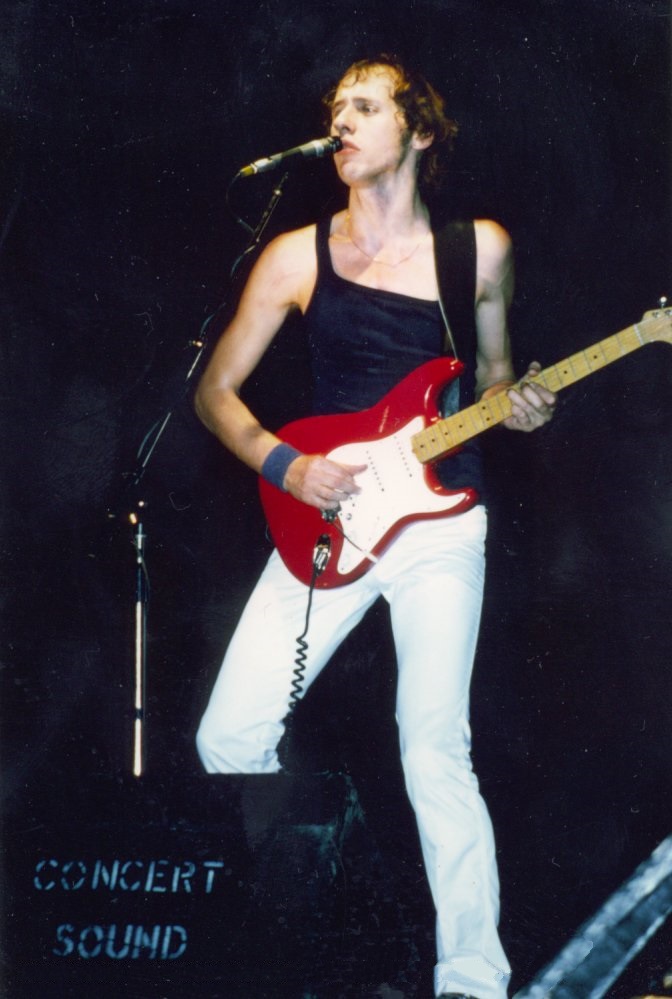
When Knopfler finally acquired his first Fender Stratocaster — a 1961 model — he had the original paint stripped and the guitar repainted in red to look like Hank Marvin’s red Strat. It was not a vintage collector’s decision. It was a twenty-something guitarist making his guitar into the instrument he had been dreaming about since childhood.
That repainted 1961 Stratocaster became the guitar on Sultans of Swing — the guitar that launched Dire Straits, the guitar that introduced Mark Knopfler’s fingerstyle tone to the world on the most-played rock track of 1979. His red Stratocaster alone is now valued at $150,000 to $200,000. The boy who couldn’t afford an amplifier ended up owning one of the most valuable Stratocasters on earth.
By the mid-1980s, Knopfler decided it was too precious to risk on tour. It went home. Other Stratocasters took its place on stage. But the red Strat remained the origin point — the instrument where everything began.
The Les Paul: Brothers in Arms and the Vintage Discovery
For the first years of Dire Straits, Knopfler was a Stratocaster man. The single-coil clarity of the Fender neck pickup suited his fingerstyle approach — warm, detailed, with the glassy quality that flesh on string produces through a good clean tube amp.
But the search for different tones led him, by the early 1980s, to the Les Paul. Mark had two Les Paul reissues in the 80s and recorded Brothers in Arms on one. However, when he later got his 1958 original, he admitted that it was a huge difference and that he should have started to play the real thing earlier.
Still inspired by the model’s unique sound, he eventually acquired two original Bursts — a 1958 and a 1959 — a few years later. Although the latter is considered the more desirable vintage, Knopfler tends to prefer the 1958. He brought both originals on tour, and his guitar technician Glenn Saggers became known for one instruction regarding them: « Stay away, don’t even look at them. »
The contrast between the Stratocaster and the Les Paul in Knopfler’s hands tells you everything about his approach to tone. The Strat for clarity, articulation, and fingerpicked detail. The Les Paul for sustain, warmth, and the particular singing quality that PAF humbuckers produce when a finger rather than a pick sets the string in motion.
The National Resonator: Romeo and Juliet’s Secret Voice

There is a guitar on Romeo and Juliet that doesn’t sound like anything else on Making Movies, or on any Dire Straits record.
It’s dry. It’s woody. It has a slight metallic shimmer and a decay that feels ancient — as if the notes are being absorbed into the wood and metal of an instrument that has its own memories. It sounds like the blues. Not British blues. American blues — Delta blues, front-porch blues, the blues that Muddy Waters and Robert Johnson played before they ever plugged into an amplifier.
Mark recorded Romeo and Juliet on his 1937 National « O » Style resonator. The resonator guitar was developed in the late 1920s to give acoustic guitarists more volume before amplification was widely available — a metal cone inside the body, driven by the bridge, projecting sound with a brightness and volume that a standard wooden acoustic couldn’t match. Blues players adopted it immediately. The sound became synonymous with the Delta, with slide guitar, with the raw emotional directness of early American blues.
Knopfler’s use of the 1937 National on Romeo and Juliet was not a production decision. It was a tonal choice — the recognition that this song, this story of romantic frustration and street-corner poetry, needed an instrument that sounded like it came from somewhere older and more honest than a recording studio in London. The National delivered that. Every time.
The Collection Today: A Journey in Instruments
Mark Knopfler’s guitar collection is estimated to be worth between $5 and $10 million, comprising over 100 instruments with many rare vintage pieces valued at $50,000 and above each.
But the number and the value are not the point. What’s remarkable is its coherence — every instrument acquired for a specific musical reason, every guitar chosen because it could do something the others couldn’t. The red Strat for clarity and sentimental weight. The 1958 Les Paul for sustain and warmth. The National for the voice of the Delta. Martin acoustics for the folk and Celtic colors of his solo work.
The boy who pressed his nose against the music shop window and couldn’t afford an amp became one of the most thoughtful and musically intentional guitar collectors in the world. Not because he wanted instruments. Because he wanted sounds — and he understood, more deeply than most, that certain sounds live in certain pieces of wood and metal and wire, and nowhere else.
Fascinated by the technique behind these instruments? Read our deep dive into Mark Knopfler’s fingerstyle approach and the Claw technique. And for the foundational right-hand method that shaped his entire playing, explore our guide on Travis Picking vs. Chicken Picking.
Tags: Mark Knopfler guitars, Mark Knopfler red Stratocaster, Brothers in Arms Les Paul, National resonator Romeo and Juliet, Dire Straits guitar tone, 1958 Les Paul, Hank Marvin Stratocaster, Tone & Gear

No Comments