
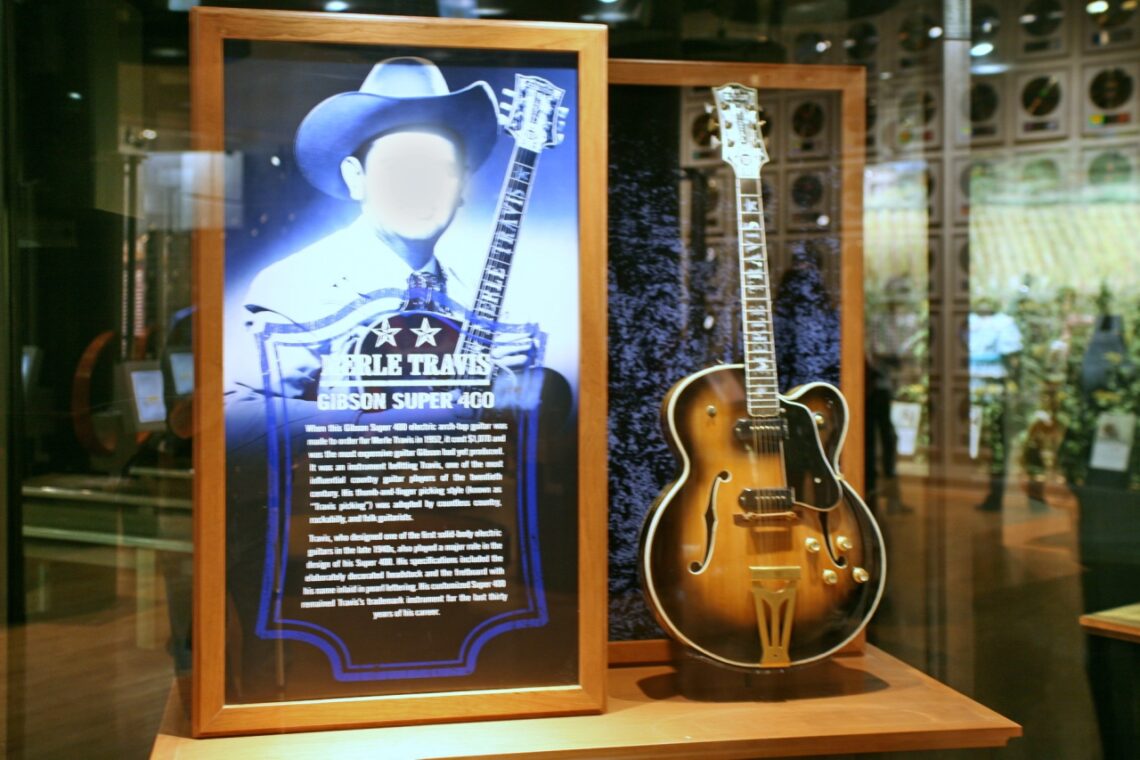
Muhlenberg County, Kentucky. 1930s. The coal mines run deep under the hills here. Men go down in the morning and come back up in the evening — black-faced, exhausted, lungs slowly filling with dust that will kill many of them before their time. On weekends, in the mining camps and on the porches of small houses, they play music.
Black musicians and white musicians, side by side in a way that the rest of America did not always permit, exchanging blues patterns and ragtime rhythms and old-time Appalachian melodies. A young boy named Merle Travis sits and listens. He watches the thumb. He watches the way one man’s right hand seems to do two things simultaneously — bass and melody, rhythm and lead — while everyone else’s hand can only do one.
He doesn’t know yet that what he’s watching will eventually carry his name around the world. He just knows he has to learn it. Merle Travis’s guitar style — born in these Kentucky coal fields, passed from hand to hand before it had a name — would eventually become the technical foundation of fingerstyle guitar for every generation that followed.
The Muhlenberg County Sound: Roots in the Coal Mines
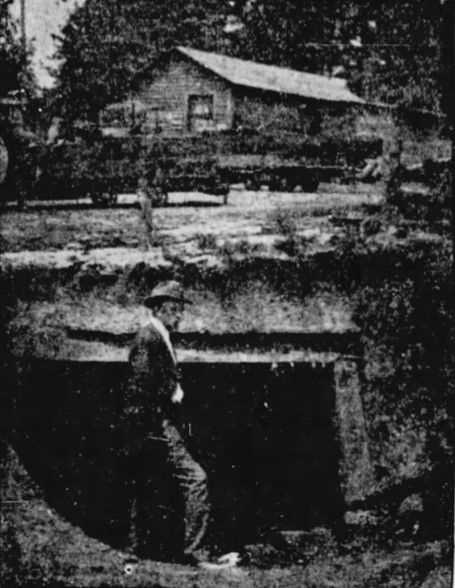
Merle Robert Travis was born on November 29, 1917, in Rosewood, Muhlenberg County, Kentucky — a coal mining region in the western part of the state where the African American and white working-class communities lived in close proximity and, in the musical spaces between shifts, influenced each other constantly.
The two guitarists most responsible for what Travis would develop were Mose Rager and Kennedy Jones — both from the same community, both players of the syncopated, thumb-driven style that had developed organically from the meeting of blues bass patterns and ragtime piano syncopation. Rager in particular was Travis’s primary model. He would sit and watch Rager play for hours, absorbing the mechanics of a style that nobody had written down or formally described.
What Rager and Jones played was not Travis picking — that name didn’t exist yet. It was a regional folk technique, passed person to person in a specific Kentucky county, rooted in the musical cross-pollination of a community where the blues and old-time country lived in the same houses and on the same porches. Travis was not the inventor of the style. He was its most gifted inheritor — the player who absorbed what his community had created and carried it to the rest of the world.
This origin matters. Travis picking did not emerge from a music school or a formal tradition. It emerged from coal country, from the intersection of Black and white Southern musical cultures, from the same creative ground that produced the blues and country music themselves. Every guitarist who plays it today is, in some indirect way, connected to those Saturday evenings in Muhlenberg County.
One Thumb, One Index: The Misunderstood Genius
Here is the historical fact that most discussions of Travis picking get wrong, or simply omit.
Merle Travis did not use multiple fingers. He used his thumb and his index finger — and only his thumb and his index finger. The thumb drove the bass with a thumbpick, alternating between bass strings in the syncopated pattern that defines the style. The index finger, often with a fingerpick, handled all the treble string work — the melody notes, the fills, the chord fragments above the bass line.
This is a critical distinction from the approach that Chet Atkins, Tommy Emmanuel, and most modern Travis pickers use. Atkins added the middle finger. Emmanuel uses middle and ring fingers. Contemporary teachers typically instruct students to use three fingers above the bass line. All of these approaches produce more melodic complexity than the original technique — but they are refinements and expansions of what Travis invented, not faithful reproductions of it.
Travis’s two-finger approach was, paradoxically, harder in some ways than the multi-finger adaptations that followed. With only one finger handling treble strings, every melody note required precise placement and timing. There was no backup finger, no option to redistribute the workload. The index finger had to do everything — and it did, producing a percussive, punchy, rhythmically driving quality that was distinctly different from the smoother, more flowing sound of later multi-finger approaches.
Listen to Cannonball Rag, Guitar Rag, or Sixteen Tons and hear it: a relentless rhythmic energy, a hard-driving forward momentum, a quality more akin to the blues from which it descended than the polished Nashville productions that came after. Travis picking in its original form was not refined. It was raw, physical, and irresistibly rhythmic.
The Solidbody Pioneer: Designing the Bigsby Guitar
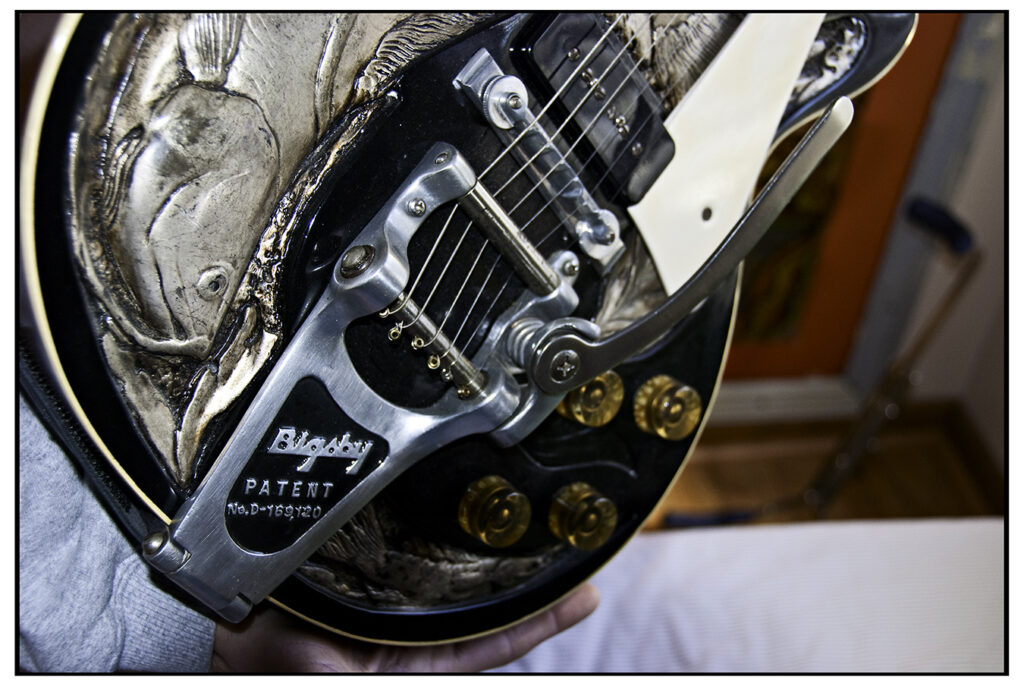
Merle Travis’s contribution to guitar history extends beyond technique.
In 1947, Travis approached Paul Bigsby — a Californian tool-and-die maker and motorcycle enthusiast who had begun building custom guitars — with a sketch. The sketch showed a guitar unlike anything in commercial production: a solid mahogany body, a long peghead with all six tuning machines on one side, a neck that joined the body at a high fret, and a cutaway for upper-register access. Bigsby built it. Travis received it in early 1948.
The Bigsby-Travis guitar predates the Fender Broadcaster/Telecaster by approximately two years and the Gibson Les Paul by four years. It is, by a legitimate historical argument, one of the first solid-body electric guitars ever built — certainly one of the first built to the specifications of a working professional musician rather than as an experimental prototype.
The influence on Leo Fender is documented. Fender saw and played the Bigsby guitar. The single-cutaway design, the six-in-line tuner configuration, the overall ergonomic logic of a solid-body electric instrument — all of it appears in the Telecaster and Stratocaster that followed. The fingerprints of Merle Travis and Paul Bigsby are on the most important guitar designs of the twentieth century.
Travis later also collaborated with Bigsby on the development of the vibrato tailpiece that bears Bigsby’s name — the same Bigsby vibrato that appears on the Gretsch Country Gentleman and countless other instruments. The connection between a Kentucky coal miner’s son and the hardware on the most elegant guitars of the 1950s and 60s is direct and documented.
The Blueprint of Modern Fingerstyle

Merle Travis died on October 20, 1983, in Tahlequah, Oklahoma, at the age of 65. He had spent his later years in relative obscurity compared to his 1940s peak — the folk revival had bypassed him somewhat, the rock era had moved past him — but among guitarists who knew what they were looking at, his status was unquestioned.
Every time a modern rock or country guitarist plays without a pick, they are walking on a road that Merle Travis paved. The syncopated thumb pattern he absorbed in the coal fields of Kentucky and took to the recording studios of Los Angeles became the technical foundation for Chet Atkins’ Nashville empire, for Mark Knopfler’s Stratocaster sound, for Lindsey Buckingham’s Fleetwood Mac arrangements, for Tommy Emmanuel’s one-man-band virtuosity.
The style that carries his name is now played in every country in the world, in every genre, by guitarists who may never have heard his name. That is the measure of a true originator: the invention outlives the memory of the inventor.
To master the mechanics of the style that bears his name, read our step-by-step breakdown of Travis Picking vs. Chicken Picking — the tutorial that connects Muhlenberg County to every fingerstyle player alive today. And to follow the chain of influence that runs from Travis to Nashville and beyond, explore our portrait of Chet Atkins: Mr. Guitar and the Nashville Legend — the man who took Travis’s blueprint and built an empire with it. And to see where that chain leads in the rock world, read how Mark Knopfler redefined rock guitar with the same foundational technique.
Explore more stories of the pioneers who built modern guitar in our Blues & Rock Legends section.
Tags: Merle Travis guitar style, origin of Travis picking, Kentucky thumbpicking, country blues pioneers, Merle Travis legacy, Paul Bigsby guitar, solid body electric history, Blues & Rock Legends


No Comments