

There is a moment in The Dance — Fleetwood Mac’s 1997 live reunion concert — where Lindsey Buckingham stands alone at a microphone with an acoustic guitar and plays Never Going Back Again. No band. No backing. Just a man and six strings.
What follows is three minutes of right-hand technique so precise and so fast that audiences who have heard the studio recording dozens of times still lean forward in disbelief. Two simultaneous bass lines. A melody running above them. A rhythmic pulse that never falters. From one guitar, through ten fingers, with no pick. Lindsey Buckingham’s guitar technique is one of the most singular, physically demanding, and musically effective approaches in the history of rock — and it has never been successfully imitated.
The California Folk Roots: No Room for a Plectrum
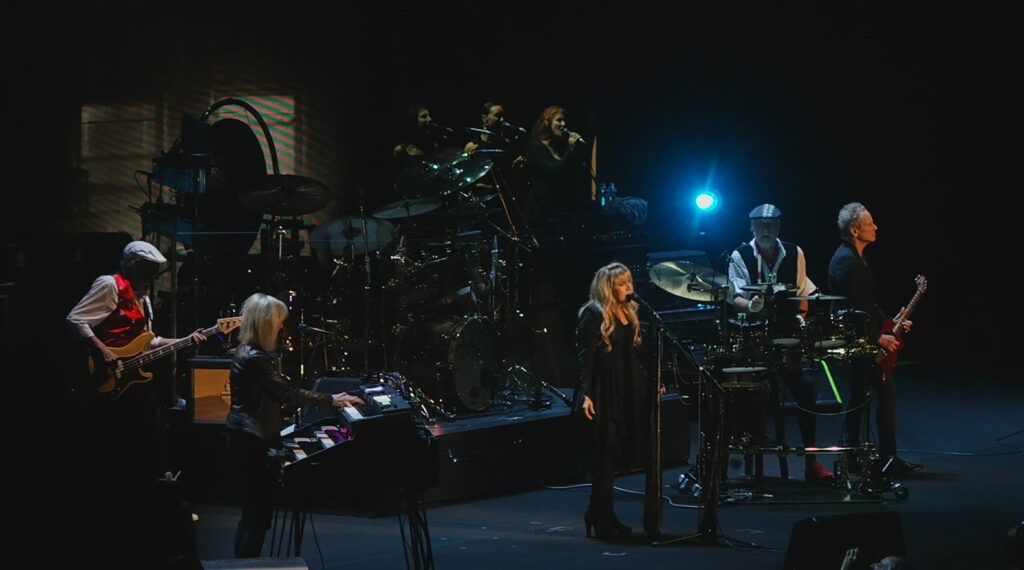
Lindsey Buckingham was born in Palo Alto, California, in 1949, the youngest of three brothers in a competitive, athletic family. The guitar arrived when he was seven years old — a gift from his older brother Jeff, a folk enthusiast who introduced him to the Kingston Trio and the finger-picked acoustic styles of the early 1960s folk revival.
This is the foundation of everything. Buckingham learned guitar the way millions of American teenagers learned it in the early 1960s — on an acoustic, with fingers, playing folk patterns that demanded right-hand independence from the very beginning. By the time electric guitars and rock music entered his vocabulary, the fingerstyle approach was already hardwired. The pick was never part of the picture.
At Stanford University, he met Stevie Nicks. They formed a duo, recorded a largely unnoticed album, and were eventually invited to join a struggling British band called Fleetwood Mac in 1974 as a package deal. The band’s commercial fortunes changed almost immediately. But Buckingham’s technique had been fully formed for years before any of it happened.
The California folk tradition — open-tuned acoustics, fingerpicked arpeggios, the melodic complexity of players like John Fahey and Leo Kottke — runs through everything Buckingham plays, even at his most aggressive. The acoustic guitar didn’t just teach him how to play. It taught him how to think about the relationship between bass, rhythm, and melody as independent voices that one instrument can carry simultaneously.
Never Going Back Again: The Ultimate Right-Hand Nightmare
Never Going Back Again, from Rumours (1977), is three minutes and twenty-three seconds long. It is one of the most demanding fingerpicking pieces in the rock repertoire, and it sits on one of the best-selling albums in the history of recorded music.
The piece is built on a double alternating bass pattern — two bass lines running simultaneously in an interlocking rhythm that creates the sensation of a rolling, perpetual motion groove. Above this double bass engine, a melody moves in and out, sometimes carried by a single note, sometimes implied by the rhythmic pattern itself. The whole arrangement is in Drop D tuning, which allows Buckingham to produce the deep low D bass note that anchors the entire piece.
At full tempo — which is brisk — the right hand is executing somewhere between ten and twelve individual finger movements per second with clean articulation on every note. There is no room for imprecision. A single mistimed finger produces an audible error in a piece with nowhere to hide.
What makes this genuinely extraordinary is that Buckingham has been performing this piece live, consistently and accurately, for nearly fifty years. On The Dance, at forty-seven years old. On tour into his sixties. The physical discipline required to maintain that right-hand precision over decades of performance is staggering.
Breaking down the right hand: the pattern uses thumb on the bass strings — alternating between low D and A in the Drop D tuning — index finger on the G string, and middle finger on the B and high E strings. The thumb drives a steady alternating pulse while the fingers handle the melodic content above it — exactly the Travis picking independence principle, pushed to its absolute physical limit.
The difficulty is not in the individual movements. Each finger, in isolation, is doing something simple. The difficulty is in the coordination — maintaining four independent rhythmic streams simultaneously at tempo. Start at 50% of the recorded tempo. Accept that it will take months to reach the full speed cleanly. Buckingham himself has said he doesn’t think about the mechanics anymore — the right hand runs on autopilot while the left hand and his voice do the conscious work. That level of automation is the goal. It doesn’t come quickly.
Bleeding for the Music: The Aggressive Electric Snap
The acoustic discipline is one half of Buckingham’s story. The other half is what happens when he plugs in.
His primary electric guitar for much of his career with Fleetwood Mac was the Turner Model 1 — a custom instrument built by luthier Rick Turner, designed specifically for Buckingham, with an unusual active pickup system and a semi-hollow body that produced a tone unlike any standard production guitar. The Turner Model 1 is not famous in the way a Les Paul or a Stratocaster is famous. It is famous specifically because Buckingham played it — and because the sound it makes under his right hand is extraordinary.
What Buckingham does with his fingers on an electric guitar is not gentle. He attacks the strings with the same aggressive force he uses acoustically — pulling and snapping with a physicality that, over the course of a long touring schedule, genuinely broke the skin of his fingertips. He has spoken in interviews about bleeding during performances, about the physical toll of playing at the intensity he demands from himself, about refusing to use a pick even when his fingers were raw.
The tone this produces is unmistakable. On Go Your Own Way, on The Chain, on Big Love — the electric snap of flesh against steel string, amplified and driven hard, creates a percussive, almost violent attack that no flatpick produces. The notes have a physical presence. You can hear the impact. You can hear the intention.
The Pop-Rock Metamorphosis of Travis Picking
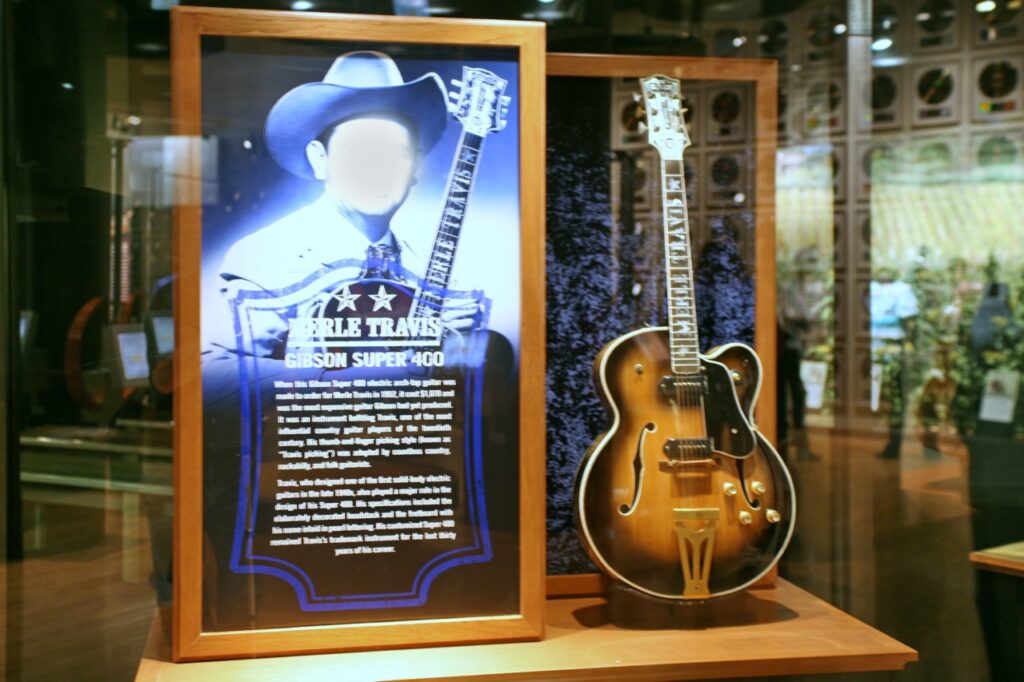
What makes Buckingham so unique in rock history is how he took a traditional acoustic folk engine and weaponized it for massive pop-rock anthems.
Most rock guitarists who grew up playing folk fingerstyle left the technique behind when they went electric, adopting the flatpick approach that rock music conventionally demands. Buckingham never made that trade. He carried the acoustic logic into every electric context, every arena, every radio-ready production, and in doing so created a body of work that sounds like nothing else in the rock canon.
His entire rhythmic drive is anchored in a hyper-speed version of classic fingerstyle. The Fleetwood Mac catalog is, underneath its polished pop production, a sustained demonstration of what Travis picking sounds like when it’s taken seriously by someone who refuses to compromise it. To deconstruct the mechanics behind this style, explore our full tutorial on Travis Picking vs. Chicken Picking — the foundational technique that Buckingham pushed into entirely new territory.
And to understand the full story of how Buckingham replaced a blues legend and reinvented an entire band with these bare hands, read our article on Lindsey Buckingham after Peter Green — how he reinvented Fleetwood Mac.
Explore more player deep-dives and technique guides in our Playing Blues & Rock section.
Tags: Lindsey Buckingham guitar technique, Fleetwood Mac guitar style, Never Going Back Again picking, rock fingerpicking pioneers, Turner Model 1 guitar, Travis picking rock, Playing Blues & Rock


No Comments