
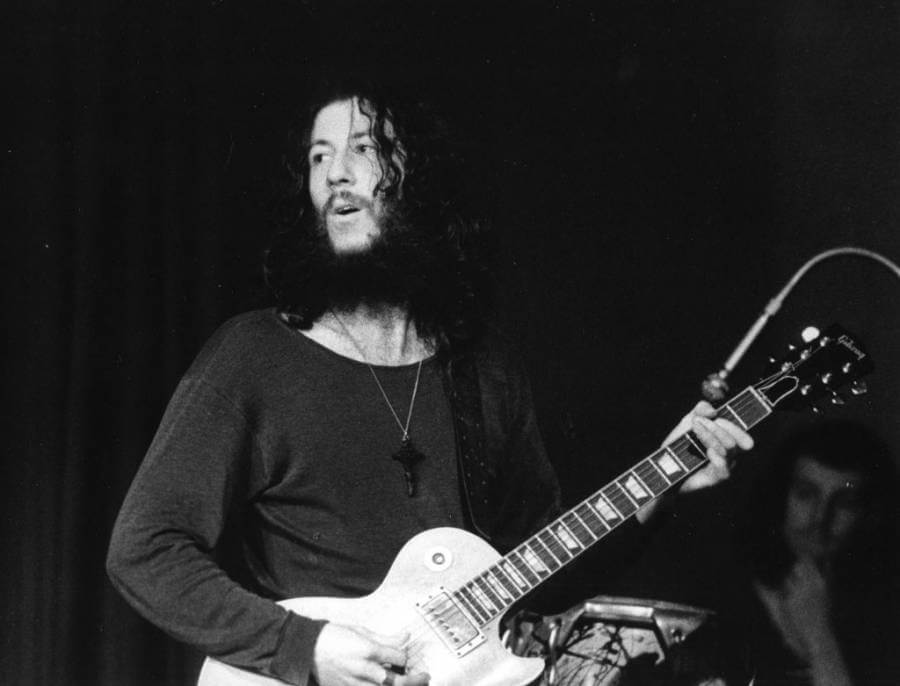
BB King — the most celebrated blues guitarist of the twentieth century, a man who had heard every great player alive — was once asked about Peter Green.
His answer has been quoted ever since, because no other answer is possible: « He was the only one who gave me the cold sweats. »
Not Clapton. Not Hendrix. Not Beck. A working-class Jewish boy from Bethnal Green in East London, who bought a Les Paul Standard secondhand for £114, who named his band after his rhythm section out of humility, who walked away from one of the greatest careers in British music at the precise moment it reached its summit. Peter Green’s Fleetwood Mac guitar story is one of the most extraordinary — and most tragic — in the history of rock.
The Roots of a Genius: What Peter Green Listened to Before Making History
Peter Allen Greenbaum was born on October 29, 1946, in Bethnal Green — a working-class district in East London’s East End, bomb-scarred from the war, a long way in every sense from the Mississippi Delta. He left school at fifteen to work as a butcher’s delivery boy. He had been playing guitar since he was ten.
What shaped him was not formal training. It was import vinyl.
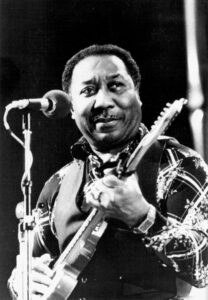
Like his peers from that golden generation, he devoured the American records that trickled over from the States, thrilling to the primal touch of US titans like Freddie King, Otis Rush, John Lee Hooker, Buddy Guy — and perhaps most palpable in his own playing — the one-note master, BB King.
This is the detail that unlocks Peter Green’s playing. His heroes were not the flashy technicians. They were the emotional architects — the players who understood that a single note, bent precisely and vibrated with the right intention, could say more than twenty notes played fast. BB King above all was the model: economy, soul, the vibrato that seems to breathe rather than mechanically oscillate.
By his mid-teens, Green had graduated from The Shadows to venerating Muddy Waters and the other Chicago bluesmen who had moved north to escape Jim Crow and had electrified the Delta blues in the city’s Southside clubs.
The British Blues boom of the mid-1960s was a specific, intense, almost missionary phenomenon. A small circle of young guitarists — Clapton, Beck, Green, Mick Taylor — had decided that American blues was the most important music in the world, and that their job was to understand it completely and honor it faithfully. They played the Marquee Club, the Crawdaddy, the Flamingo. They listened to the same records. They watched each other play with the competitive attention of students trying to understand a master text.
What set Green apart in that circle was not speed or technique — several of his contemporaries had more of both. It was the quality of his feeling. He approached the blues the way BB King approached it: not as a style to be imitated but as an emotional language to be spoken. Every note was intentional. Nothing was wasted.
Replacing the Irreplaceable: John Mayall’s Bluesbreakers
In 1966, Eric Clapton left John Mayall’s Bluesbreakers to form Cream. He left behind an audience that had spray-painted Clapton Is God on London walls. He left behind a standard that most guitarists would not have attempted to meet. Peter Green met it — and then went further.
It was Clapton, Green recalled, who changed his trajectory: « I decided to go back on lead guitar after seeing him with the Bluesbreakers. He had a Les Paul, his fingers were marvellous. The guy knew how to do a bit of evil, I guess. »
« Peter Green was the next in line, » Mayall shrugged in 2012. « That was a no-brainer. »
What Green brought to the Bluesbreakers was a style immediately distinct from Clapton’s. Where Clapton played with controlled ferocity — the Les Paul cranked through a Marshall, producing the singing sustain that defined the Beano album — Green played with an airiness that was harder to categorize and ultimately harder to resist. His tone was thinner, more vocal, more nakedly emotional. His vibrato — learned from BB King but made entirely his own — had a slow, wide, vocal quality that made every sustained note sound like a human voice reaching for something just out of grasp.
The Bluesbreakers audiences, prepared to mourn Clapton, found themselves converted immediately. Read the full story of the institution that shaped both of them in our article on John Mayall’s Bluesbreakers — the ultimate guitarist incubator.
The Birth of Fleetwood Mac: The Original Blues-Rock Monster
Peter Green did not stay in the Bluesbreakers long. By 1967, he had a vision for something of his own.
He recruited drummer Mick Fleetwood — whose thunderous, physically imposing style suited the heavy blues Green was hearing in his head — and bassist John McVie, whose melodic but rock-solid bottom end had been the foundation of the Bluesbreakers’ sound. Then he named the new band after them.
Not after himself, the guitarist and songwriter and acknowledged genius of the enterprise. After the rhythm section.
« Peter could have been the stereotypical superstar guitar player and control freak, » Mick Fleetwood told The Irish Times. « But that wasn’t his style. He named the band after the bass player and drummer, for Christ’s sake. »
Peter Green’s Fleetwood Mac debuted in 1968 — a blues-rock powerhouse of the highest order, built on heavy guitar, thunderous rhythm, and songs that ranged from Delta tradition to original compositions of genuine sophistication. Black Magic Woman — later made famous by Santana. Oh Well — a two-part masterpiece that opened with one of the most authoritative riffs in British rock. Albatross — a hypnotic instrumental that reached number one in the UK charts. The Green Manalishi (With the Two Prong Crown) — a dark, churning nightmare of a song that Green claimed came to him in a dream.
This was not the pop-rock band that Rumours would make famous a decade later. This was a blues monster — raw, heavy, spiritually serious, and led by a guitarist who BB King said was the only one who gave him the cold sweats.
The Magic of « Greeny »: The Phenomenal Peter Green Les Paul
The Out-of-Phase Secret Behind Peter Green’s Guitar Tone
Peter Green found his 1959 Les Paul Standard Sunburst in 1965 at Selmer Music in London, buying it for £114 — the same shop on Charing Cross Road where Clapton, Beck, and Jimmy Page bought their instruments. He took it to the Bluesbreakers and then to Fleetwood Mac.
What made the guitar unique was an accident — and the nature of that accident has been debated for sixty years.
The guitar is famed for its honky, out-of-phase tone on its middle pickup switch setting, the result of the neck pickup having been accidentally installed with reversed polarity from the factory. When both pickups are selected simultaneously — middle position on the selector — the reversed polarity creates a partial phase cancellation, producing a thin, nasal, hollow tone that sits between a standard Les Paul and a Stratocaster. Kirk Hammett described it as sounding like « a Strat through a 100-watt Marshall stack. »
Green had claimed it was the result of his own tinkering. Other accounts suggest a repairman accidentally rewound a pickup. In reality, the pickup was installed that way from the start as a factory error, confirmed by guitar tech Jol Dantzig when he examined the guitar in 1984.
There is one final irony. Peter Green felt there was nothing particularly special about the guitar or his sound. He didn’t even know what « out-of-phase » meant. The man who created one of the most sought-after tones in guitar history had no idea how he’d done it.
The Guitar That Outlived the Man
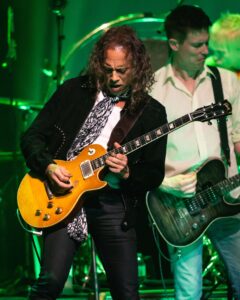
Greeny passed through three famous sets of hands. Peter Green sold it to Gary Moore — the Irish blues guitarist who worshipped Green with the same intensity that Tommy Emmanuel worshipped Chet Atkins. Moore used it for over thirty years, recorded an entire tribute album called Blues for Greeny in 1995, and eventually was forced to sell it in 2006 due to financial difficulties.
In 2014, Metallica’s Kirk Hammett acquired it for a reported $2 million. He plays it live every night — refusing to let it become a museum piece. The Gibson Custom Shop produced limited Greeny replicas in 2010 and 2022, and added it to their core lineup in 2023. The full story of the guitar’s journey — and the technical secrets behind its tone — is told in our dedicated article on Greeny: the mythical 1959 Les Paul that made rock history.
The Departure and the Legacy
In early 1970, after a disastrous experience at a hippie commune in Munich, Peter Green’s mental state shattered. He began giving his money away, urging the band to donate their earnings to charity, losing his grip on the reality that had produced such extraordinary music. He left Fleetwood Mac at the peak of their powers and tumbled into decades of struggle.
The band he left behind spent years trying to find direction. The rhythm section of Mick Fleetwood and John McVie held the name together while the music searched for an identity. Then, in 1975, a California couple arrived. The guitarist’s name was Lindsey Buckingham. He played no pick. He came from folk music. He was the opposite of Peter Green in almost every way. And everything changed again.
The Transition to Lindsey Buckingham

Peter Green’s departure forced Fleetwood Mac through years of reinvention before finding its next identity. The blues-rock monster he built gave way, eventually, to something entirely different — a California pop-rock phenomenon driven by acoustic fingerpicking, alternate tunings, and a right-hand technique that nobody else in the rock world had.
Neither chapter diminishes the other. Green built the foundation. Buckingham built the next floor. Read the full story of how Lindsey Buckingham reinvented Fleetwood Mac after Peter Green.
Want to explore more legends who shaped the blues and rock? Browse our full Blues & Rock Legends section — where every story connects to the music that came before and after.
Tags: Peter Green Fleetwood Mac guitar, Peter Green Les Paul Greeny, British blues boom, Fleetwood Mac original lineup, out-of-phase guitar tone, Gary Moore Greeny, Kirk Hammett Les Paul, John Mayall Bluesbreakers, Blues & Rock Legends

No Comments