
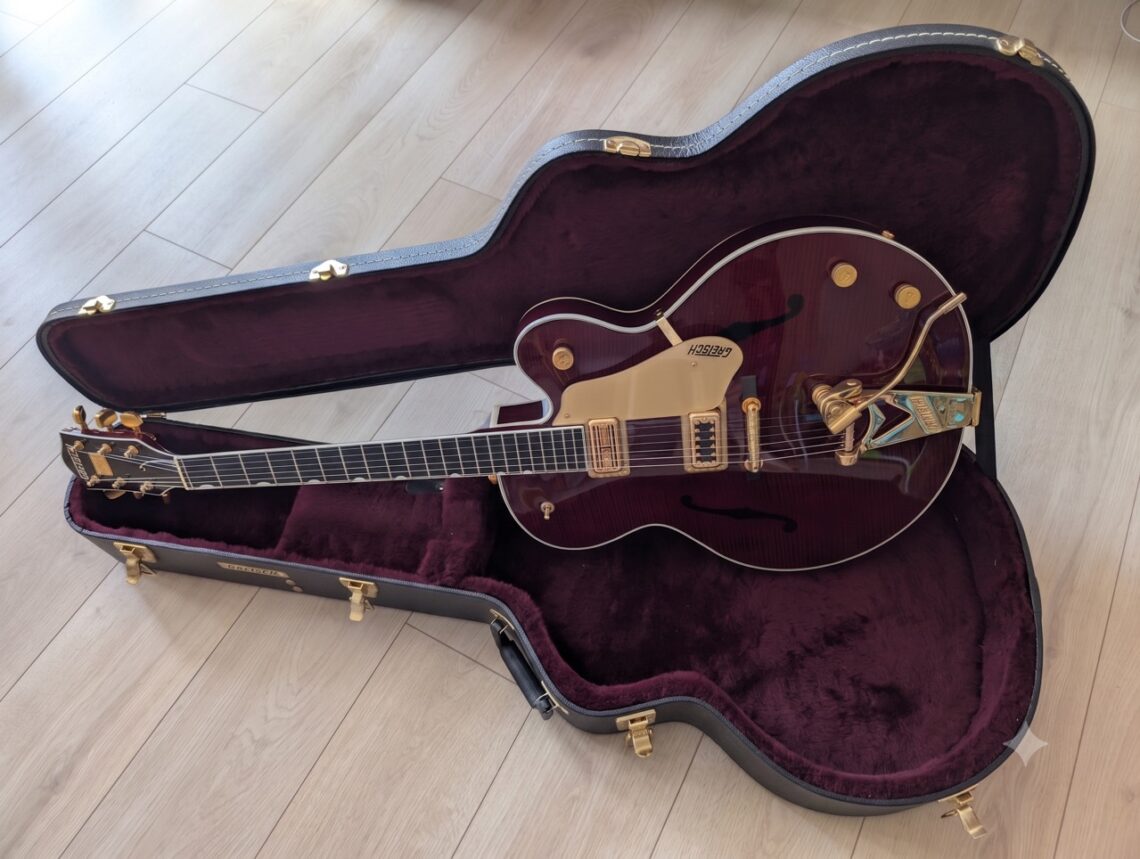
After months of hunting — scrolling listings, cross-referencing serial numbers, analyzing photos at 3am, walking away from guitars that were almost right — I finally found one that stopped the search.
A Gretsch Country Gentleman Single Cut. Serial number JT14. Terada factory, Nagoya, Japan, 2014. Original case, full documentation, gold hardware worn naturally where hands have rested. Near perfect condition.
I paid €1,850. I’d do it again without hesitation.
This is my field report.
The Terada Heritage: Why the JT Series Defies Modern Custom Shops
There’s a conversation that happens in vintage guitar circles that always surprises newcomers: the argument that certain Japanese-built instruments are simply better than their American counterparts. Not better in some abstract nationalistic sense — better in the specific, measurable sense of consistency, finish quality, wood selection, and assembly precision.
The Gretsch JT series sits at the center of that conversation.
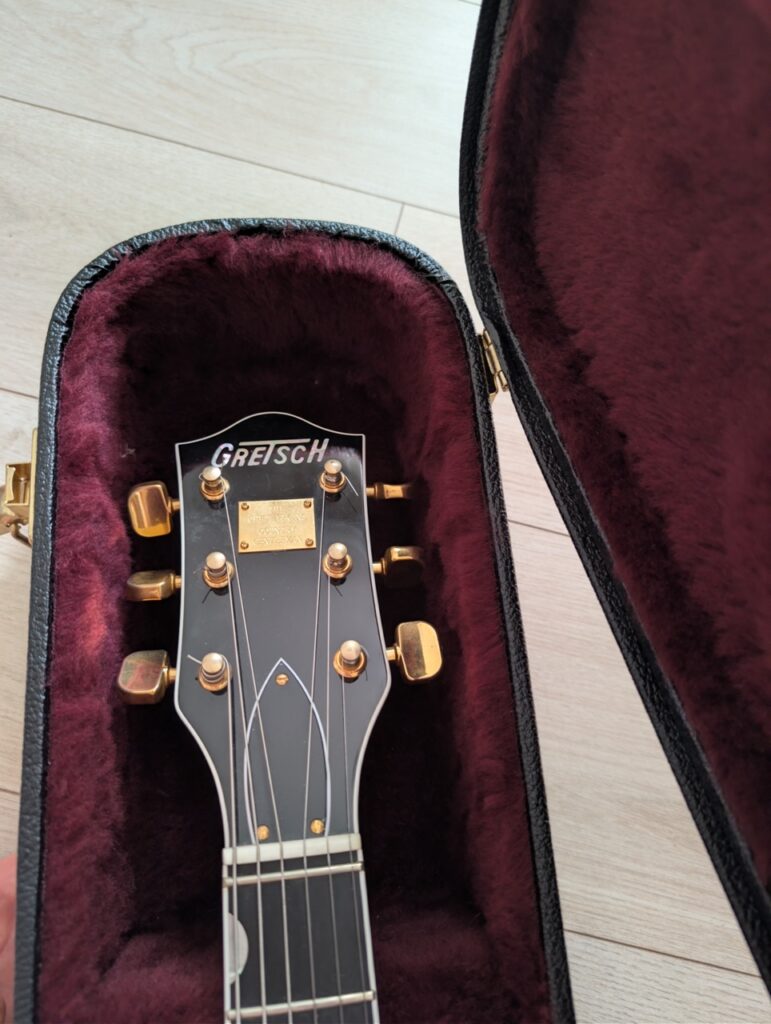
The « J » in JT stands for Japan. The « T » stands for Terada — a factory in Nagoya that has been building instruments since 1955 and has produced guitars for Gretsch’s Professional Collection since Fred Gretsch reclaimed the family brand in 1985, following the difficult years under the Baldwin Piano Company’s ownership. The number that follows — 14 in my case — indicates the year of manufacture. My Country Gentleman was built in 2014.
What Terada brings to these instruments is something that no marketing language can fully capture — you feel it the moment you pick one up. The neck joint is immaculate. The binding is precise and even around every curve. The finish has a depth and consistency that is genuinely difficult to achieve at scale. Every fret is level and dressed. The hardware sits flush and tight.
These are not accidents. Terada employs craftspeople who have been building Gretsch guitars for decades — who know the tolerances, the specifications, the details that matter. The result is an instrument where nothing feels approximate. Everything is exactly what it should be.
Many serious players who have owned both vintage American Gretsch instruments and modern Terada-built Professional Series models will tell you the same thing: the Terada guitars are more consistent. Not more characterful — that’s a different conversation — but more reliably excellent, instrument to instrument. For a buyer on the secondhand market who wants a Country Gentleman that plays and sounds exactly as it should, the JT series is the safest and most satisfying choice available.
The Anatomy of an Icon: Single Cut vs. Double Cut
The Country Gentleman has existed in two primary configurations since its introduction in 1957: the original single cutaway, and the double cutaway that arrived in 1961 and became the dominant form through much of the guitar’s later production history.
The distinction matters more than it might appear on the surface.
The single cut — the configuration of my JT14, and the configuration that George Harrison played on the Ed Sullivan Show — has a larger, more continuous body mass on the bass side of the instrument. The top bout remains full and uninterrupted. This affects the resonance characteristics of the instrument in subtle but real ways: the single cut Country Gentleman has a slightly warmer, fuller low-end response, a slightly more pronounced body resonance, and a physical presence in the hands that feels more substantial and authoritative.
The double cut, by contrast, offers easier access to the upper frets — practical for a lead player who needs to reach the 17th and above — and has a slightly more balanced, symmetrical visual character. It’s the configuration associated with Harrison’s later Gretsch period, and with many of the reissues and signature models that followed.
For purists — and for anyone specifically chasing the sound and feel of early Beatles recordings, of those first Chet Atkins records on RCA, of the Country Gentleman in its original and most historically significant form — the single cut is the only choice. It is the original vision. It is the guitar as Chet Atkins and Gretsch designer Jimmie Webster conceived it in 1957. Everything else, however excellent, is a variation.
Real Patina: Why You Should Never Clean Bigsby Gold Hardware
My Country Gentleman came with something that no new guitar can offer: honest, earned wear.
The gold plating on the Bigsby B7 vibrato and on the Tune-O-Matic bridge shows the natural wear pattern of a guitar that has been played. Where the right hand rests — across the bridge, along the arm of the Bigsby — the gold has worn through to the underlying metal, leaving a softened, slightly darker tone in exactly the places where a human body has made contact for years.
Some buyers would see this as a flaw. I see it as the most authentic thing about the guitar.
There is a particular kind of collector who, upon acquiring an instrument with this kind of natural patina, immediately reaches for a polishing cloth and a bottle of metal cleaner. I’d encourage you strongly not to do this. The wear pattern on aged gold hardware is not corrosion, not neglect, not damage — it is the physical record of use. It tells you the instrument was played, loved, and taken seriously by whoever owned it before you. It cannot be replicated artificially in any convincing way. And once you polish it away, it’s gone.
The Bigsby on my Country Gentleman looks exactly the way a Bigsby should look on a guitar that has been played. It looks like Chet Atkins’ guitars look in concert footage from the 1960s. It looks like a working instrument, not a display piece.
Leave the patina alone. It’s not a flaw. It’s the story.
From Simulated F-Holes to the Boom-Chick Tone
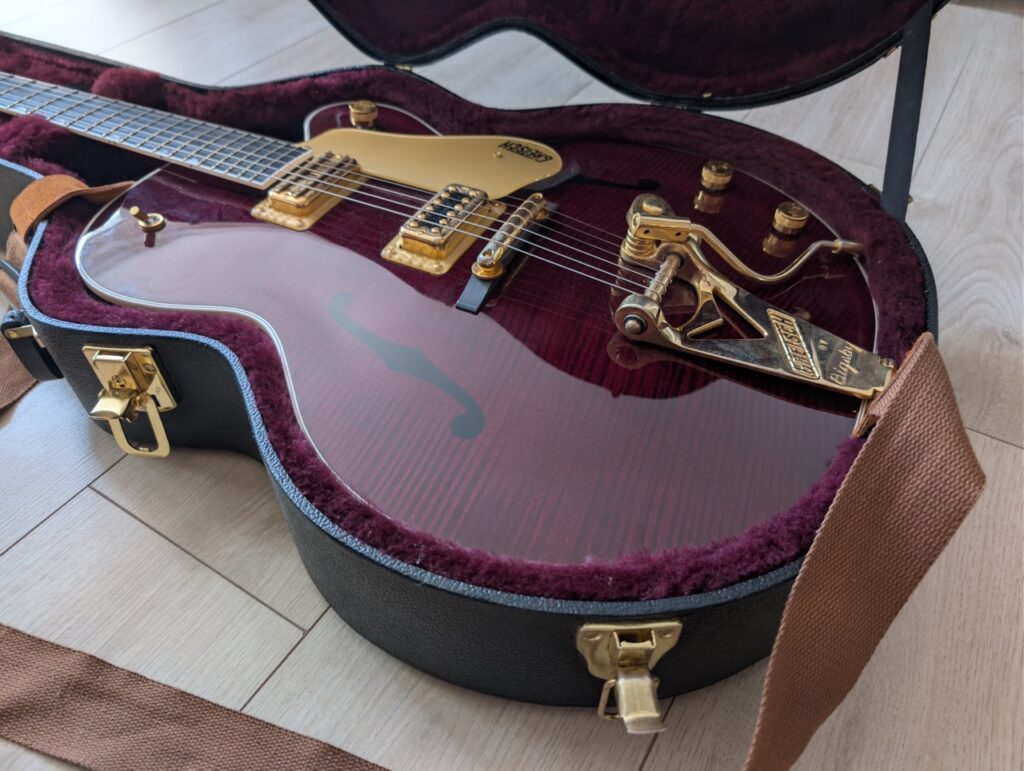
Pick up a Country Gentleman for the first time and you will almost certainly run your finger along one of the f-holes. You will notice, with some surprise, that the wood is completely smooth beneath it. No opening. No cut through the top. The f-holes are painted directly onto the sealed maple surface.
This is not a cost-cutting measure or a manufacturing quirk. It is a deliberate engineering decision that Chet Atkins himself requested, and it is fundamental to what makes the Country Gentleman sound the way it does.
In the 1950s and early 1960s, hollow body guitars amplified at stage volumes had a persistent feedback problem. The open body resonated with the speaker output, creating an uncontrollable howl that limited how loud a player could go before the guitar took on a life of its own. Chet Atkins, performing in large venues with powerful amplification, needed a solution. Working with Gretsch and engineer Ray Butts, he developed the sealed-top design: close the body, eliminate the parasitic resonance of an open top, and paint the f-holes to maintain the visual identity of a traditional archtop. The guitar remained hollow inside — but the top was now fixed and controlled.
The result is the boom-chick tone that defines the Country Gentleman’s voice: a rich, full low-end attack on the bass strings — the « boom » — paired with a bright, articulate snap on the treble strings — the « chick. » The Filter’Tron humbuckers, developed by Ray Butts and also introduced at Chet’s request, contribute the rest: a clarity and note separation that sits somewhere between a single coil’s transparency and a PAF humbucker’s warmth, without the hum of either.
It is an immediately recognizable sound. You know it from Chet Atkins’ Workshop and Country Gentleman. You know it from the early Beatles records. You know it from every great rockabilly and country session of the late 1950s and early 1960s. And when you play one through a clean amplifier at moderate volume, you understand immediately why this combination of design decisions produced something that nobody has ever fully replicated.
The Missing Link Between Liverpool and Nashville
A guitar like this one sits at an extraordinary intersection of musical history.
In Nashville, Chet Atkins — session guitarist, producer, RCA Records vice president, and the man whose name appears on the headstock — used the Country Gentleman to define the sound of an entire genre. The smooth, sophisticated Nashville Sound of the late 1950s and early 1960s, the records that made country music accessible to a mainstream American audience, ran through instruments exactly like this one.
In Liverpool, a twenty-year-old guitarist named George Harrison bought a Country Gentleman because he’d been chasing an American sound that he couldn’t quite reach with anything else. He took it to New York. He played it on the most-watched television program in American history. And the next morning, an entire generation of young Americans decided they needed a Gretsch.
The single-cut Country Gentleman is the instrument that connects those two worlds — Nashville sophistication and Liverpool enthusiasm, country fingerpicking and rock and roll energy, the careful craft of Chet Atkins and the joyful abandon of the early Beatles.
My JT14 is a 2014 instrument. But when I play it through a clean Vox amp with the Filter’Trons wide open, the distance between 2014 and 1964 becomes very small indeed.
Want to go deeper on the history behind this guitar? Read our full story on George Harrison’s Gretsch Country Gentleman — the Ed Sullivan guitar and its tragic fate. And to truly understand how to make this wooden beast sing, explore our guide on Chet Atkins’ fingerstyle secrets and the Country Gentleman sound.
This guitar also appears in my ongoing Vintage Guitar Hunting journal — the field report of how I tracked it down.
Tags: Gretsch Country Gentleman Single Cut, Gretsch JT14, Terada factory Gretsch, Chet Atkins Country Gentleman, Filter’Tron tone, vintage Gretsch review, boom-chick tone, Tone & Gear


No Comments