
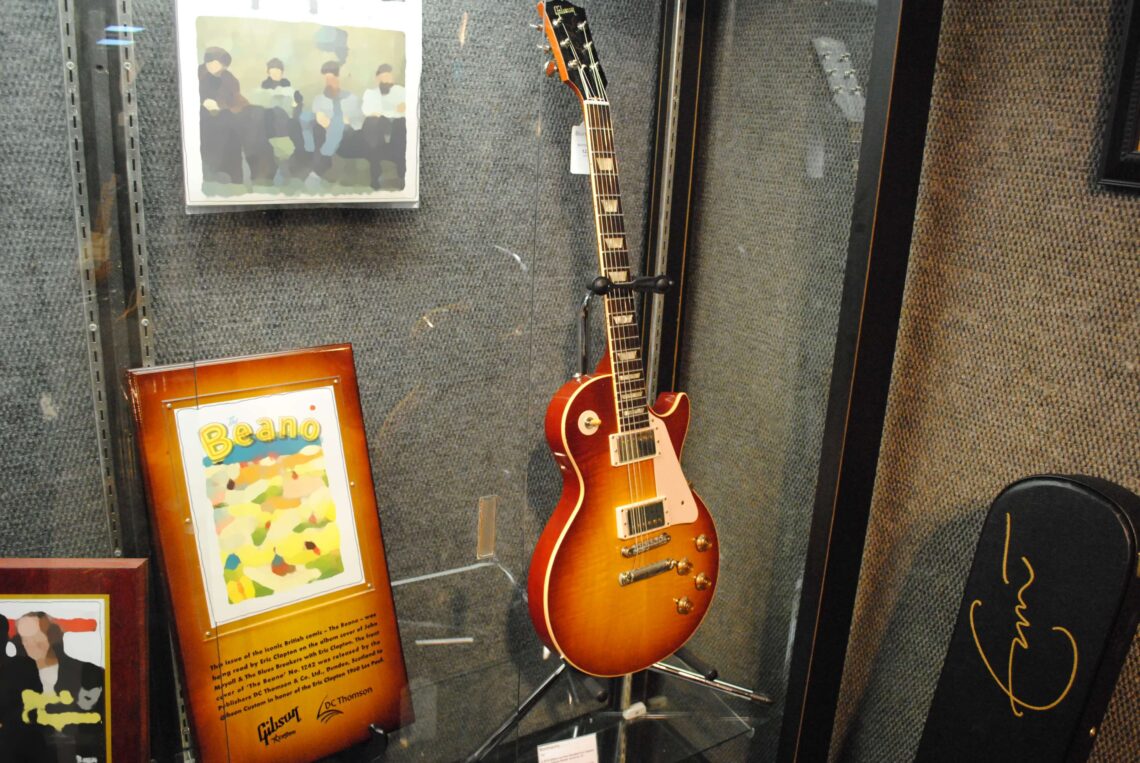
London, 1966. Somewhere on a wall in the city, someone has spray-painted three words that are stopping pedestrians in their tracks: Clapton is God.
The graffiti has been appearing for months — on underpasses, on tube station walls, on the brickwork of pubs where the blues is played loud and late. And the guitar responsible for that reputation, the instrument that made an entire generation drop to their knees, is a sunburst Les Paul that a young Eric Clapton bought secondhand from a shop on Charing Cross Road for 105 guineas.
That guitar — the Beano Burst — has not been seen since the summer of that same year.
This is its story.
The Sound That Changed Everything: Clapton and the 1960 Les Paul Standard
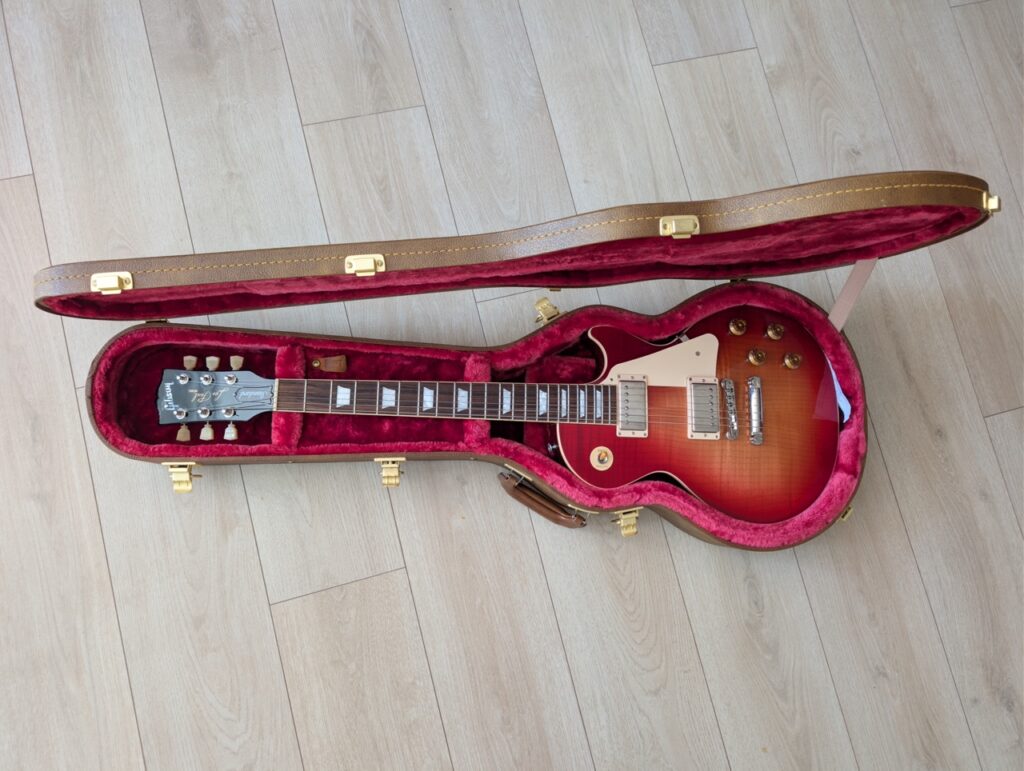
It started, as so many great guitar stories do, with an album cover.
When Eric Clapton spotted Freddie King on the sleeve of Let’s Hide Away and Dance Away — King’s hands wrapped around a gold-top Les Paul — something clicked. Clapton understood immediately that the sound he was chasing lived inside a Gibson. He walked into Lew Davis’s guitar shop on Charing Cross Road in London and found it: a sunburst Les Paul Standard, most likely from 1960, though sources have debated whether it was a 1959 or 1960 model ever since. Clapton never noted the serial number. He didn’t think he’d need to.
The guitar had a slim neck — a detail Clapton would later recall specifically, and one that points toward 1960, when Gibson transitioned away from the thick baseball-bat profiles of the late 50s. It came in its original case, lined with purple velvet. Clapton called it, simply, the best Les Paul I ever had.
He took it into the studio with John Mayall and the Bluesbreakers in early 1966. What came out of those sessions was Blues Breakers with Eric Clapton — better known, universally and immediately, as the Beano Album, named for the British children’s comic that a disinterested Clapton is reading on the cover.
The sound on that record redefined what an electric guitar could do. Through a Marshall combo cranked to the edge of breakup, the Les Paul’s humbuckers produced a singing, sustaining, almost vocal tone — thick in the midrange, responsive to every nuance of touch, capable of going from a whisper to a scream in the same breath. Clapton’s cover of Freddie King’s Hide Away, his reading of Robert Johnson’s Ramblin’ On My Mind, his incendiary lead work throughout — all of it ran through that one guitar.
The graffiti appeared shortly after the album’s release. Clapton is God. And the instrument of his divinity was a sunburst Les Paul that he’d picked up secondhand for just over a hundred pounds.
July 1966: Vanished into Thin Air
By the summer of 1966, Clapton was already moving on. The Bluesbreakers had been a launching pad — brilliant, influential, career-defining — but Clapton’s restless ambition was pulling him toward something bigger. He’d been approached by drummer Ginger Baker about forming a new band. Baker brought in bassist Jack Bruce. The three of them began rehearsing at a church hall in Brondesbury, north-west London, in July 1966.
They knew almost immediately they had something extraordinary. The chemistry was unlike anything any of them had experienced. The volume was enormous. The interplay between three virtuosos with nothing to prove and everything to explore was electric in the most literal sense.
And then, sometime during those rehearsals, Eric Clapton’s Les Paul was stolen.
No dramatic confrontation. No forced entry. Just gone. Taken from the rehearsal room while the band’s attention was elsewhere — the casual, opportunistic theft that ended up becoming one of the most significant disappearances in the history of rock and roll.
Clapton himself later confirmed the guitar was stolen during the Cream rehearsals, leaving him in the position of borrowing guitars while scrambling to find a replacement. For his first public appearance with Cream at the Twisted Wheel in Manchester, and the band’s debut at London’s Marquee Club on August 16th, he was playing other instruments — a cherry red 1960 Les Paul Special, possibly borrowed, while he sorted out what came next.
What came next was the psychedelic Gibson SG Standard that would define the visual identity of Cream — the one painted by the Dutch art collective The Fool in swirling cosmic patterns, the one every guitarist of a certain age can picture immediately. Then came the Stratocasters, the Blackie era, the second act of one of the most storied careers in guitar history.
But the Beano Burst was gone. And Clapton, for all his subsequent guitars, never forgot it.
« I never really found one as good as that, » he said years later. « I do miss that one. »
Myths, Sightings, and Private Collections: Where Is It Now?
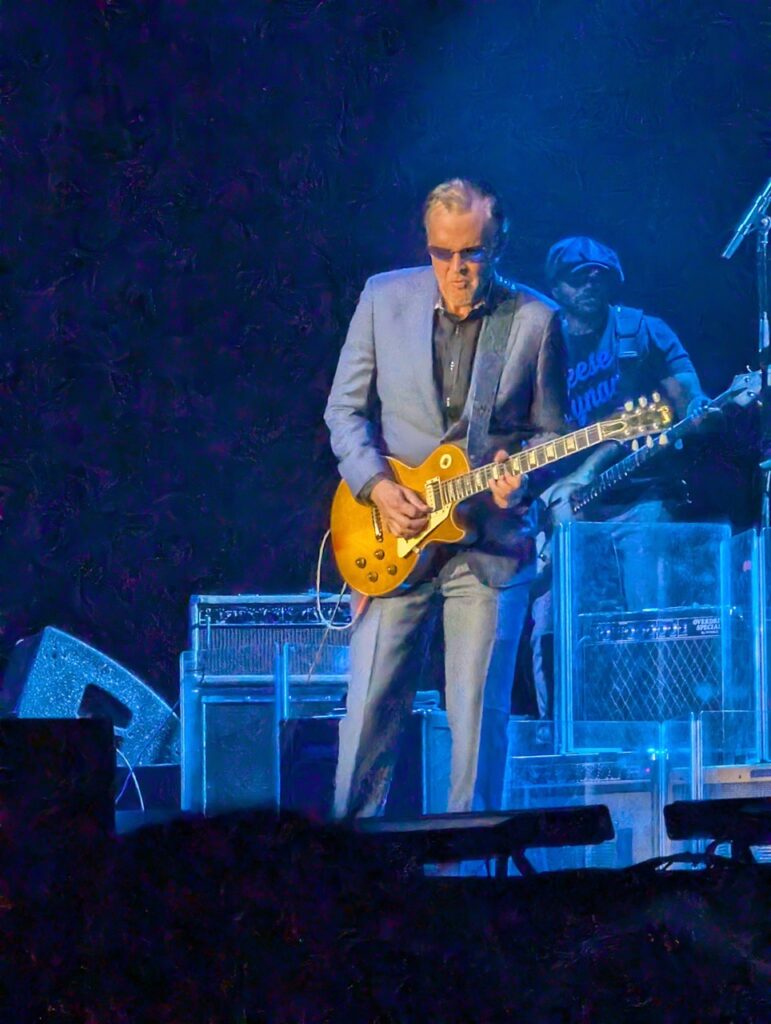
Fifty-nine years have passed since the theft. The guitar has never officially resurfaced. But it hasn’t entirely disappeared from conversation either — and one particularly tantalizing thread has kept the mystery alive for the better part of a decade.
In 2016, Joe Bonamassa told Guitarist magazine that the guitar was in a private collection on the East Coast of America — and went further, claiming it was actually a 1959 model, not a 1960, with a double-white humbucker in the neck position and a double-black in the bridge, and a relatively plain top. « It still exists, » Bonamassa said, « and I haven’t seen it, but I have it on good authority from people who have. And it’s got the little fingerprint by the pots and they can trace it back. »
He hasn’t said more since. He’s confirmed he hasn’t purchased it — because it’s stolen property, and acquiring a stolen instrument of this magnitude would carry consequences that no private collection is worth. But the implication is clear: someone, somewhere on the American East Coast, owns a guitar they almost certainly know the full history of.
The theories about how it got there are plentiful. The most common: a thief who had no idea what he’d taken sold it quickly and cheaply, it passed through several hands over the years, and eventually landed in a collection whose owner either doesn’t know its provenance or knows it all too well and has no intention of surfacing it.
Clapton never noted the serial number — a detail that complicates any official identification and means authentication would rely on physical characteristics: the specific humbucker configurations Bonamassa described, the neck profile, the finish checking patterns, and whatever forensic traces remain around the control cavity pots.
Clapton has said publicly that he’d welcome being reunited with the guitar. Whether that reunion is possible — legally, practically, emotionally — depends entirely on whoever is holding it, and whether they’re ready to come forward.
So far, the silence has been total.
The Hollywood Parallel: When Holy Grails Disappear
The Beano Burst isn’t alone in the pantheon of missing stringed legends. Rock history has a strange and recurring relationship with guitars that vanish at the precise moment they’ve achieved mythological status — as if the universe decides that some instruments are too significant to remain in circulation.
From smoky rehearsal rooms in north-west London to the polished floors of Hollywood sound stages, the pattern repeats. A guitar becomes inseparable from a defining moment in culture. Then it disappears. And in its absence, the mythology grows to fill the space the object left behind.
The « Lost Guitar » Curse reaches even into cinema. The Back to the Future Guitar — the Cherry Red Gibson ES-345 that Marty McFly played during that legendary Enchantment Under the Sea dance scene — has never been found either. Gibson launched a worldwide search for it in 2025, enlisting Michael J. Fox, Christopher Lloyd and the original cast in the hunt. The guitar remains at large. In the meantime, Gibson built 88 Custom Shop replicas and 1,985 Epiphone tributes — and both sold out within hours.
→ Read our full deep dive: The Back to the Future Guitar: Nostalgic Scam or Real Collector’s Deal?
Both stories follow the same arc. An instrument achieves something irreplaceable in a specific moment of music or culture. It disappears. The world builds a mythology around the absence. And the replicas, the tributes, the limited editions — however beautifully crafted — only underscore the point: you cannot manufacture what has been lost.
The Beano Burst, if it exists somewhere on the East Coast of America, is not just a valuable guitar. It is a physical recording of a specific moment in 1966 when a young man from Surrey channeled the Mississippi Delta through a Marshall amplifier and made an entire city believe he was divine.
No replica carries that weight.
Every Guitar Teaches You Something: The Legacy of a Ghost
There is a philosophical footnote to the Beano Burst story that doesn’t get told often enough.
The theft, for all its tragedy, forced Eric Clapton to keep moving. He couldn’t settle into the comfort of an instrument that already felt perfect — the Les Paul that sang exactly right, the guitar he’d already mastered. Instead, he moved to the SG, then to the Stratocaster, then through a lifetime of searching, experimenting, adapting. The Blackie Strat. The Brownie. The Custom Shop Signature series. The Crossroads auctions. An entire second and third chapter of tone exploration that might never have happened if the Beano Burst had stayed safely in the rehearsal room in Brondesbury.
The greatest guitarists are always in motion. The loss of one perfect instrument doesn’t end the journey — it deepens it. Clapton’s post-Beano career is proof. So is the fact that he’s still playing, still searching, still chasing a tone that satisfies.
The guitar that’s still out there in a collection somewhere on the East Coast of America carries more than its provenance. It carries the reminder that the quest for the perfect sound never ends at a single instrument.
Even the greatest ones get away sometimes. And the search — the real search — is what makes us better players.
Fascinated by the guitars that shaped rock history? Explore more stories in our Blues & Rock Legends section — and follow the ongoing hunt for exceptional instruments in our Vintage Guitar Hunting journal.
Tags: Beano Burst, Eric Clapton Les Paul 1960, stolen guitar mystery, holy grail guitars, missing vintage guitars, Gibson Les Paul Burst, Clapton Bluesbreakers, guitar mysteries, Blues & Rock Legends

No Comments