
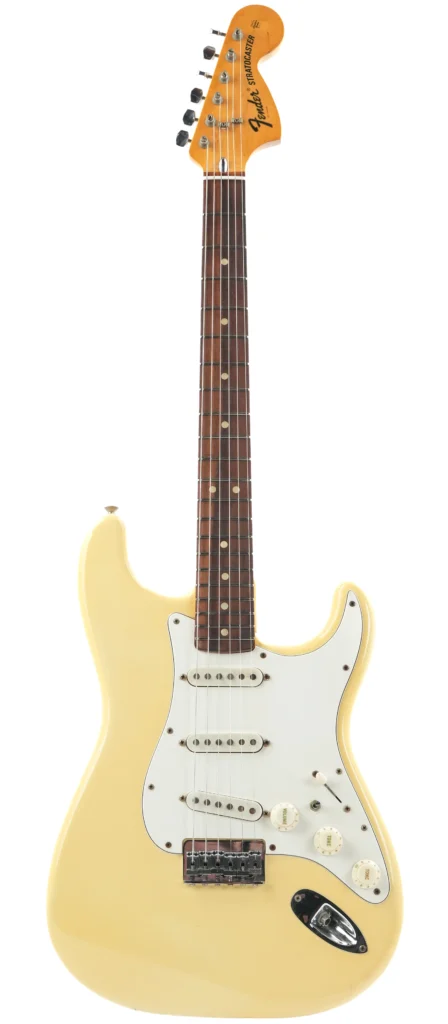
We’ve all been there. You’re scrolling through an amazing website shop such as Fellowship of Guitar, your heart skips a beat, and there it is: a 1975 Fender Stratocaster in a stunning, faded Vintage Cream.
I already own a 1979 Stratocaster, but it’s a « player grade » instrument—it has lived a long life and shows it. My goal was to find a « Mint » early seventies specimen to take my collection to the next level. On paper, this 1975 was « The One. » But in the vintage world, the deeper you dig, the more you realize that a dream guitar can sometimes be a trap.
1. The 3.2kg Miracle (The CBS Unicorn)
If you know anything about mid-to-late 70s Fenders, you know they are notorious for being « boat anchors. » Usually, they hover around 4kg (8.8 lbs) or more.
To give you some perspective, my 1979 Strat weighs almost 4.2kg (9.2 lbs)—it’s actually heavier than my 2024 Gibson Les Paul Standard! So, finding a 1975 Strat that weighs only 3.2kg (7 lbs) felt like finding a unicorn. That light weight promised incredible resonance and that « airy » feel that makes a Stratocaster sing. It was the strongest argument in favor of this guitar.
2. The Tech Analysis: Everything Looked Perfect
At first glance, this guitar checked every single box on the vintage enthusiast’s checklist. I spent a long time analyzing the details:
- The Body: The paint was absolutely impeccable—a rare sight for a 50-year-old instrument.
- The Hardware: It was a Hardtail (fixed bridge) version, featuring the original bridge and saddles (pontelets). It also had the original tuners and the iconic jack plate.
- The Neck & Headstock: It featured the unmistakable Big Headstock style, typical of the seventies. I noticed the double « T » string trees (guides-cordes) were correct for the period. Most importantly, it had the iconic Bullet Truss Rod nut at the headstock, a hallmark of Fender engineering from 1971 to 1978. The back showed the classic 3-bolt plate with a matching serial number.
- The Plastics: The pickguard, pickup covers, and Volume/Tone knobs were all original, showing just the right amount of aging.
- The Electronics: It housed the three original 1975 Greybottom pickups, which are the heart and soul of this era’s sound.
3. Iconic Tone: From Nile Rodgers to Blackmore
The sound of a 1975 is exactly what I look for. With those Greybottoms, the clean tones have that classic Nile Rodgers (Chic) funky « clack » in the 2nd and 4th positions—think of the razor-sharp rhythm on « Le Freak ».
But what is really amazing is the lead tone. As soon as add the overdrive, the grain and sustain are incredibly close to Ritchie Blackmore’s legendary sound, specifically that biting bridge pickup tone heard on « Burn ». It has that aggressive yet musical edge, with the perfect amount of mid-range « honk. »
4. The Price: A 4,200€ Dilemma
At 4,200€, we are in serious territory. To put this in context:
- It’s the price of a high-end Fender Custom Shop.
- It’s the starting price for certain Vintage Gibson ES-335s from the late 70s or early 80s, which are becoming increasingly difficult to acquire in such clean condition.
- While it’s far from a €10,000 Murphy Lab, we are definitely in the range of a premium boutique investment.
At this price, a vintage piece is an investment. A new guitar loses value the second you leave the shop, while a clean 1975 Strat should only go up—as long as it’s in a mint condition.
5. The Dealbreaker: Integrity over Weight
Here is where the dream hit a wall. For 4,200€, I expect 100% integrity or at least 98%.
While one potentiometer had been repaired/replaced due to normal wear and tear (which is acceptable), the rest was a no-go.
The guitar had an added switch with a visible drilling in the pickguard and, more importantly, potential drilling in the wood underneath to accommodate a modified circuit.
In the vintage market, originality is king. A hole in the body is a permanent scar on its soul and its resale value. It transforms a « Collector’s Piece » into a « Modified Player. »
Conclusion
I could have tried to negotiate the price down from 4,200€ to 3,600€. However, when dealing with a highly reputable shop like Fellowship, asking for a 15% discount is almost unimaginable. So I didn’t even try (maybe I missed it).
More importantly, I am specifically looking for a 100% non-modified instrument. I don’t care about « mojo » like finish wear, or even a clean pro-refretting job. But I draw the line at electronic modifications and holes in the wood.
I’ve decided to keep hunting. I’d rather wait for a 3.6kg Strat that is untouched than settle for a 3.2kg featherweight with a compromised history. The search for the perfect early 70s « Mint » Strat continues!

No Comments