
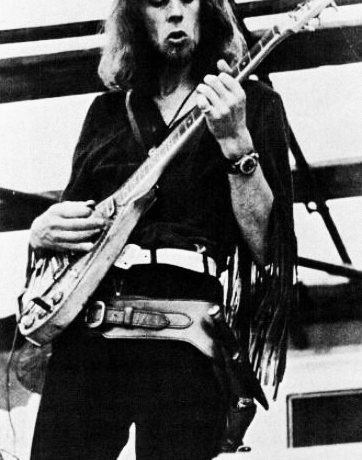
Freddie King hit the blues world like a freight train, and the nickname his fans gave him tells you everything: the Texas Cannonball. Where his contemporaries often leaned on subtlety, King leaned on force. His playing was loud, physical, and relentlessly rhythmic. It was built on a right-hand attack that felt less like picking a guitar and more like striking one. That aggression, paired with a string of instrumental hits in the early 1960s, made Freddie King one of the most influential blues guitarists America ever produced. Decades later, his fingerprints are still visible on rock guitar today.
What made King’s sound so distinctive wasn’t just his technique. It was the collision of two worlds in a single guitarist: the electrified, horn-driven urban blues of Chicago, and the looser, acoustic-rooted phrasing of the Texas and Southern blues he grew up around. That fusion shaped everything that followed, including a hardware setup that evolved from a 1954 Gibson Les Paul Goldtop to a Gibson ES-345. Together, guitar and gear gave him a tone as singular as his attack.
The Bridge Between Chicago and Texas Blues
Freddie King was born in Gilmer, Texas, in 1934. He moved to Chicago as a teenager, which put him directly in the orbit of the city’s booming postwar blues scene. This geography mattered enormously to how he played. Chicago blues in the 1950s was electric, urgent, and driven by amplified urban energy — think Muddy Waters and the sound coming out of Chess Records. However, King never fully let go of the southern, acoustic-rooted phrasing he’d absorbed growing up in Texas, where the blues carried a looser, more vocal-like swing.
The result was a hybrid style that few of his peers could match. King could drive a band with the same electric intensity as any Chicago guitarist. Yet his phrasing retained a rural elasticity, bending notes with a vocal quality that felt closer to a shout than a lick. It’s this blend — urban drive fused with southern feel — that made his playing feel both aggressive and deeply expressive at once.
That hybrid approach reached its clearest expression on the instrumentals that would define his career and reshape the vocabulary of electric guitar for the next generation.
Instrumentals That Changed Guitar History: « Hide Away » and « San-Ho-Zay »
In 1960 and 1961, Freddie King released a run of instrumental singles. They became essential listening for an entire generation of guitarists on both sides of the Atlantic. « Hide Away » is the most famous of these — a tune built on a driving shuffle and a series of guitar hooks so catchy that it became a blueprint other players would study note by note. « San-Ho-Zay » followed a similar formula: a tight, danceable groove wrapped around King’s biting, percussive lead lines.
These weren’t just hit records. They were guitar lessons disguised as singles, and they landed in the hands of British musicians right as the UK blues boom was taking shape. The directness of King’s playing on these tracks stands out — no wasted notes, no ambiguity in the attack. That made them ideal material for young guitarists trying to learn how electric blues actually worked.
Freddie King’s Guitars: From Goldtop to ES-345
Freddie King’s tone evolved alongside his gear. Tracing that evolution tells you almost as much about his sound as listening to the records themselves.
The Early Years: 1954 Gibson Les Paul Goldtop with P-90 Pickups
During the « Hide Away » era, King’s main instrument was a 1954 Gibson Les Paul Goldtop loaded with P-90 single-coil pickups. The P-90 is a fundamentally different animal from the humbuckers that would later become synonymous with Les Pauls. It’s grittier, more midrange-forward, and reacts to pick attack with far more immediacy. In King’s hands, that responsiveness became a weapon. Every accent, every dig into a string, translated directly into the tone coming out of the amp — exactly what his aggressive playing style demanded. Browse 1950s Gibson Les Paul Goldtops on Reverb to see original and reissue examples currently listed.
The Signature Era: Gibson ES-345 with Varitone
As his career progressed, King moved to a Gibson ES-345, a semi-hollow guitar equipped with the Varitone rotary tone selector. The ES-345 gave him a rounder, woodier midrange than the Goldtop. Meanwhile, the Varitone allowed for tonal shading that could shift the character of a solo without touching an amplifier knob. This guitar became so closely associated with King that it’s now considered part of his signature sound, right alongside the ES-345s later favored by other blues and rock guitarists who followed his lead.
Attack and Technique: Metal and Plastic Picks
Beyond the guitars themselves, Freddie King’s most idiosyncratic contribution to blues guitar technique was physical: how he actually struck the strings.
Combining a Plastic Thumb Pick with a Metal Index Pick
King played with a plastic thumb pick on his thumb and a metal fingerpick on his index finger. This combination gave him control over two distinct textures in the same phrase. The plastic thumb pick delivered a rounder, warmer attack useful for rhythm and lower-string work, while the metal index pick cut through with a sharp, percussive bite on lead lines. Very few blues players of his era combined materials this way. As a result, it’s a major part of why his tone still sounds so immediately recognizable decades later.
Piercing Bridge Pickup Bite and Physical Attack
Combined with the bridge pickup — which King favored for its cutting, aggressive character — this picking hybrid produced a tone that seemed to leap out of the speaker. It wasn’t a subtle sound. It was meant to dominate a room, and it did.
The British Blues Explosion Connection
How Eric Clapton Plugged a Les Paul into a Marshall Because of Freddie
Freddie King’s influence on the British blues explosion of the 1960s is difficult to overstate. Young guitarists across England were devouring American blues records, and King’s instrumentals landed with particular force because they were so directly translatable — riff-based, guitar-forward, and built for study. Eric Clapton has cited King’s playing as a key influence during his time with John Mayall’s Bluesbreakers. The combination Clapton became famous for — a Les Paul driven hard through a Marshall amp — owes a real debt to the tone King had already been chasing with his Goldtop and P-90s years earlier. That sound, sometimes called the « woman tone, » traces a direct line back to the aggressive midrange bite King had pioneered on the other side of the Atlantic.
Conclusion: The Unstoppable Energy of Freddie King
Freddie King never played it safe, and that’s precisely why his influence has outlasted so many of his more polished contemporaries. He fused Chicago’s electric urgency with Texas’s vocal phrasing, and built a picking technique that let him blend warmth and bite in the same breath. He also left behind a run of instrumentals that taught a generation of guitarists — from Eric Clapton onward — how to play electric blues with real force. Decades later, the Texas Cannonball’s attack still hits just as hard. If you’re chasing that tone yourself, browse original and reissue Gibson ES-345 models on Reverb to compare what’s currently available.
For more on the guitarists who shaped this era, explore our Blues & Rock Legends section, including our features on Keith Richards, B.B. King, and Albert King.
Tags: Freddie King, Freddie King Gibson ES 345, 1954 Les Paul Goldtop P90, Hide Away guitar tone, Texas blues pioneer, Blues & Rock Legends

No Comments