The blues is the soul of guitar music, and while basic triads (major and minor chords) lay the foundation, mastering advanced chords like 7ths, 9ths, and 13ths unlocks the rich, soulful sound of legends like B.B. King, Stevie Ray Vaughan, and Eric Clapton. If you’re ready to move beyond A, E, and D chords and add depth to your blues playing, this ultimate guide is for you.
In this article, we’ll explore essential advanced blues guitar chords, how to use them in classic progressions, and tips to make your playing stand out. Plus, we’ve included chord diagrams, tablatures, and video references to help you nail that authentic blues tone.
Whether you’re an intermediate guitarist or a seasoned player looking to spice up your chord vocabulary, let’s dive into the world of advanced blues chords and take your playing to the next level.
Why Advanced Chords Matter in Blues Guitar
Blues is all about emotion, and advanced chords add color, tension, and release to your playing. While basic triads (like E major or A minor) are the backbone of blues, they can feel repetitive without variation. It’s like improvising with pentatonic scales. After a while you need to spice it up otherwise your audience will get bored.
Chords like dominant 7ths, 9ths, and 13ths introduce bluesy-jazzy, soulful flavors that make your progressions sound professional and expressive.
Think of B.B. King’s smooth transitions in “The Thrill Is Gone” or Stevie Ray Vaughan’s gritty chord work in “Pride and Joy.” These legends rely on advanced chords to create texture and keep listeners hooked. By mastering these chords, you’ll not only expand your sound but also stand out in jam sessions or recordings.
1. Revisiting the Basics: Triads and Dominant 7ths
Before diving into advanced chords, let’s quickly recap the foundation of blues chords:
- Major and Minor Triads: These are three-note chords (root, third, fifth). For example, an E major triad is E-G#-B, and an A minor triad is A-C-E.
- Dominant 7th Chords: The cornerstone of blues, these add a flattened seventh to the major triad. For example, E7 is E-G#-B-D. In a standard 12-bar blues in E, you’d use E7 (I), A7 (IV), and B7 (V).
Here’s a quick E7 chord diagram for reference:
E7 Chord (Open Position)
e|---0---
B|---0---
G|---1---
D|---0---
A|---2---
E|---0---
Practice Tip: Play a 12-bar blues progression in E (E7-A7-B7) to get comfortable with dominant 7ths. Strum with a shuffle rhythm to capture that classic blues feel. Start with a slow BPM and accelerate the tempo when you feel comfortable (it might take you few days to get use to the basic new chords and few weeks/months for the more advanced ones).
2. Going Beyond: Advanced Blues Guitar Chords
Now, let’s explore the chords that give blues its distinctive flavor: 7ths, 9ths, 13ths, and diminished chords. These add complexity and are used by pros to create tension and resolution.
Dominant 9th Chords
A 9th chord builds on the dominant 7th by adding the ninth note of the scale. For example, an E9 chord includes E (root), G# (major third), B (fifth), D (flat seventh), and F# (ninth).
E9 Chord (Barre Shape):
e|---7---
B|---7---
G|---7---
D|---6---
A|---7---
E|---x---
When to use it: 9th chords add a jazzy, soulful vibe. They’re perfect for songs like “Stormy Monday” by T-Bone Walker. Try substituting E7 with E9 in a 12-bar blues for a smoother sound.
Dominant 13th Chords
13th chords are even richer, adding the 13th note (a sixth above the octave). An E13 chord is E-G#-B-D-F#-C#.
E13 Chord (Open Position):
e|---0---
B|---0---
G|---1---
D|---2---
A|---4---
E|---0---
When to use it: 13th chords are common in Chicago blues or jazz-blues hybrids. Try them in turnarounds (the last two bars of a 12-bar blues) for a sophisticated finish.
Diminished Chords
Diminished chords create tension, often used as passing chords. An E diminished 7th (Edim7) is E-G-Bb-Db.
Edim7 Chord:
e|---x---
B|---2---
G|---3---
D|---2---
A|---x---
E|---x---
When to use it: Use diminished chords to transition between I and IV (e.g., E7 to Edim7 to A7) for a dramatic effect, as heard in Robert Johnson’s “Kind Hearted Woman Blues.”
3. Advanced Blues Guitar Chords : Applying Progressions
To make these chords practical, let’s apply them to a standard 12-bar blues progression in E. Here’s a basic version using only 7th chords:
E7 | E7 | E7 | E7 |
A7 | A7 | E7 | E7 |
B7 | A7 | E7 | B7 |
Now, let’s spice it up with advanced chords:
E7 | E9 | E7 | E13 |
A7 | A9 | E7 | E9 |
B7 | A7 | E7 | Edim7 | B7 |
Tab Example (Turnaround with Edim7):
E7 Edim7 B7
e|---0----------x----------2---
B|---0----------2----------0---
G|---1----------3----------2---
D|---2----------2----------1---
A|---2----------x----------2---
E|---0----------x----------x---
Practice Tip: Record yourself playing this progression and experiment with substituting E7 for E9 or E13 in different bars. Listen to how the added notes create a richer sound.
4. Techniques to Enhance Your Chord Playing
Advanced blues guitar chords sound best when paired with techniques. Here are a few to try:
- Hammer-ons and Pull-offs: Add hammer-ons to transition between chords (e.g., hammer from E to G# in an E9 chord).
- Slides: Slide into chords for a gritty blues feel, like Stevie Ray Vaughan.
- Open Voicings: Use open strings in chords like E13 for a fuller sound.
- Muting and Raking: Mute unused strings and rake across chords for a percussive effect, as heard in Muddy Waters’ style.
Video Reference (To be published soon) : Check out this YouTube tutorial on advanced blues guitar chords to see these in action.
5. Real-World Examples: Chords in Iconic Blues Songs
To inspire you, here’s how advanced chords appear in classic blues tracks:
- “Stormy Monday” (T-Bone Walker): Uses 9th chords (G9, C9) for a jazzy feel. Try playing G9 instead of G7 in the IV chord.
- “The Thrill Is Gone” (B.B. King): Features minor 9th chords (Bm9) for a melancholic vibe.
- “Crossroads” (Cream/Eric Clapton): Incorporates 13th chords in the turnaround for a dynamic finish.
Practice Tip: Learn the chords to one of these songs and experiment with substituting 7ths for 9ths or 13ths. Share your version in the comments below!
6. FAQ: Your Questions About Blues Guitar Chords Answered
What are the essential blues guitar chords?
The core blues chords are dominant 7ths (E7, A7, B7), but advanced players use 9ths, 13ths, and diminished chords for richer sounds. These advanced blues guitar chords may look hard to replicate at the beginning but it takes just a bit of practice.
How do I transition to advanced chords?
Start by substituting one 7th chord with a 9th or 13th in a familiar progression. Practice slowly and use chord diagrams to build muscle memory.
What’s the difference between 7th and 9th chords?
A 7th chord adds the flattened seventh (e.g., E7: E-G#-B-D). A 9th chord adds the ninth note (E9: E-G#-B-D-F#) for a jazzier sound.
Which blues songs use advanced chords?
Songs like “Stormy Monday” (9ths), “The Thrill Is Gone” (minor 9ths), and “Kind Hearted Woman Blues” (diminished) are great examples.
What guitar is best for blues chords?
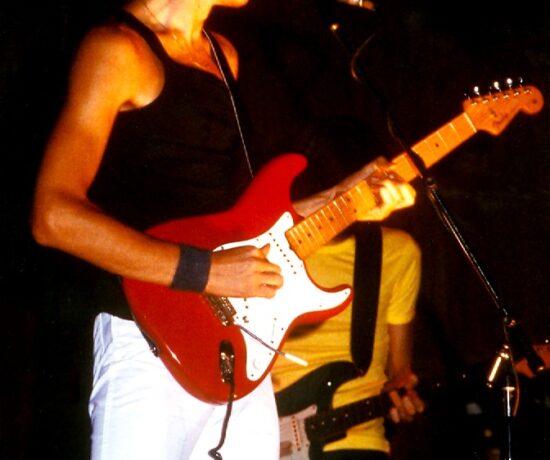
Fender Stratocasters and Gibson Les Pauls are the most popular guitars. Their versatility offers you both clean and gritty chord tones. You could also use a Gretsch but the sound is very specific (Check out Brian Setzer and Malcolm Young).
Conclusion: Elevate Your Blues with Advanced Chords
Mastering advanced blues guitar chords like 7ths, 9ths, 13ths, and diminished chords will transform your playing from basic to soulful. By incorporating these chords into your progressions, experimenting with techniques like slides and hammer-ons, and drawing inspiration from legends like B.B. King and Eric Clapton, you’ll create a sound that’s uniquely yours.
Ready to start? Try the 12-bar progression with E9 and E13 chords above, and let us know how it sounds in the comments. Want more? Download our free PDF with chord diagrams and tabs (add a link to a downloadable resource) or join our newsletter for weekly blues guitar tips. Keep the blues alive, Angie!

No Comments